Commercial Kitchen Equipment List: What Passes Inspection
By
Contents
- The Short Answer on a Commercial Kitchen Equipment List
- Why NSF Certification Comes First
- Sanitation Infrastructure: The Non-Negotiable Layer
- The Cooking Line: Driven by Menu, Not by Category
- How the Commercial Kitchen Equipment List Changes by Business Type
- Plan Review: The Step That Fixes Your Equipment Schedule
- What Buyers Get Wrong
- Beyond the Equipment: What Also Needs Ordering
- Frequently Asked Questions
- Working Order
A commercial kitchen equipment list ordered by what inspection actually requires. Published 13 September 2026. Reviewed by the Fusenpack technical team.
A commercial kitchen equipment list is usually organized by cooking function: ranges, then refrigeration, then prep, then storage. That order is comfortable to read. However, it is the wrong order to buy in. The first thing that decides whether a piece of equipment can go in your kitchen is not what it cooks. It is whether the unit will pass inspection.
A residential-grade griddle cooks perfectly well. However, it will still fail a health inspection in a commercial kitchen. Finding that out after installation is an expensive way to learn the rule. Therefore, this commercial kitchen equipment list follows the way an inspection works. It starts with the requirements that constrain every purchase, then moves to the equipment that varies by what you serve.
The Short Answer on a Commercial Kitchen Equipment List
Buy commercial equipment certified to the relevant NSF/ANSI standards. Health inspectors across the United States have required that certification for decades. Consequently, a non-certified unit can fail inspection regardless of how well it performs. In practice, sanitation infrastructure comes before cooking equipment in the buying order. Specifically: a three compartment sink with drainboards for warewashing, plus a separate handwash sink that does nothing else. Refrigeration then has to hold 41°F or below, with freezers at 0°F or below. Only after those are settled does the cooking line matter. Your menu genuinely drives that part of the list. Meanwhile, your local health jurisdiction sets the exact requirements rather than any national body. The equipment schedule therefore usually forms part of a plan review you submit before construction starts.
Why NSF Certification Comes First
NSF certification is the gate that most equipment decisions pass through. Specifically, NSF’s own description of its food equipment certification lists three things the program covers. First, material safety, so the product does not leach harmful chemicals into food. Second, design and construction, so the product is cleanable and unlikely to harbor bacteria. Third, product performance. Additionally, the certification process includes audits of the manufacturer’s facility.
The design and construction element is the one that explains why a domestic appliance fails. Notably, certified equipment carries rounded internal corners, sealed seams, and accessible surfaces. Those features let staff clean it to a sanitary standard. A residential unit with crevices that trap food debris fails on cleanability rather than on cooking ability.
NSF states that public health inspectors began requiring certification to NSF/ANSI standards after those consensus standards were developed. Since then, the requirement has spread widely. Building a new restaurant or commercial kitchen without NSF is now close to impossible. NSF/ANSI Standard 51 covers food equipment materials.
So one question belongs on every quotation you request. Is this unit certified to the applicable NSF/ANSI standard, and can you supply that certification? A mark printed in a catalog photograph is not the same thing as a listing you can check.
Sanitation Infrastructure: The Non-Negotiable Layer
Sanitation equipment does no cooking and is the least negotiable part of any commercial kitchen equipment list. It is also what an inspector looks at first.
|
Item |
Function |
Common requirement |
|---|---|---|
|
Three compartment sink |
Wash, rinse, sanitize warewashing by hand |
Drainboards on both ends; sized to your largest pot |
|
Handwash sink |
Handwashing only |
Separate from warewashing and food prep sinks; stocked with soap and towels |
|
Food prep sink |
Rinsing produce, thawing |
Often required separately from warewashing |
|
Mop or service sink |
Filling and emptying cleaning buckets |
Keeps waste water out of food sinks |
|
Grease interceptor |
Prevents grease entering the drain system |
Often specified by the plumbing authority rather than health |
|
Commercial dishwasher |
High volume warewashing |
Does not usually remove the three compartment sink requirement |
Separation is the point running through all of it. In practice, each sink has one job. Using one for two ranks among the most frequently cited violations in food service inspections. A layout that saves money by combining them usually gives that money back at plan review.
Refrigeration temperatures are part of the inspection
Fairfax County in Virginia publishes the pre-occupancy inspection criteria for new food establishments. Specifically, it wants refrigerators holding at 41°F or below and freezers at 0°F or below, with thermometers present in the units. Furthermore, the same inspection requires a certified food manager on site with an accredited exam certificate. The facility also has to be clear of construction debris.
Buy refrigeration that holds those temperatures under load in a hot kitchen, not on an empty showroom bench. Undersized refrigeration drifts above 41°F during a busy service. That is a compliance problem and a food safety problem at once.
The Cooking Line: Driven by Menu, Not by Category
Once sanitation and refrigeration are settled, the rest of the commercial kitchen equipment list follows the menu. Buying a standard set because it looks like a professional kitchen backfires. Operators end up with an expensive appliance nobody uses, and a bottleneck at the one they need.
|
Equipment |
Buy it when |
Skip or defer when |
|---|---|---|
|
Range with oven |
Sautéing, sauces, and baking in the same footprint |
The menu is entirely fried or griddled |
|
Flat top griddle |
Burgers, breakfast, high volume repeat items |
Nothing on the menu is cooked flat |
|
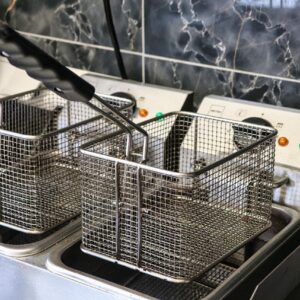
Deep fryer |
Fries, wings, anything battered |
No fried items; ventilation and fire suppression add real cost |
|
Convection oven |
Baking, roasting, holding volume |
A range oven covers the volume |
|
Combi oven |
Steam and dry heat in one unit, high volume |
The budget is tight; this is usually the most expensive single item |
|
Salamander or broiler |
Finishing, melting, gratin |
No finishing step in the menu |
|
Steam table or hot holding |
Buffet, catering, hot lines |
Everything is cooked to order |
|
Microwave, commercial grade |
Reheating components |
A domestic unit is not an acceptable substitute here either |
Ventilation deserves separate mention because it is the most common budget shock. Specifically, cooking equipment that produces grease-laden vapor needs an exhaust hood with fire suppression. That installation frequently carries a substantial cost in its own right. Meanwhile, the fire authority usually inspects it separately from the health inspection. Deciding to add a fryer late in the build is rarely just the price of the fryer.
How the Commercial Kitchen Equipment List Changes by Business Type
The sanitation layer stays broadly constant across formats. The rest of the commercial kitchen equipment list moves considerably.
Restaurant kitchen equipment list
A full-service restaurant needs the widest range. In practice that means several things at once. A cooking line matched to the menu, plus prep refrigeration at the line as well as bulk storage. Then dish return and warewashing sized for peak service, and dry storage with shelving raised off the floor. Notably, the bottleneck in most restaurant kitchens is warewashing at peak rather than cooking capacity. Plan for that before the layout is fixed.
Food truck equipment list
A mobile unit carries a compressed version of the same requirements, and space forces every item to earn its place. Tacoma-Pierce County’s mobile food unit guidance specifies a handwash sink and a three compartment sink with drainboards onboard. Additionally, it sets minimum tank capacities of 35 gallons fresh water and 42 gallons waste water. Power is the other constraint. Size the generator for the peak simultaneous load rather than the sum of nameplate ratings, then add whatever the refrigeration draws overnight.
Bakery equipment list
Baking shifts the weight of the list toward preparation and proofing rather than the cooking line. The core is a deck or convection oven, a spiral or planetary mixer sized to your largest batch, and a proofer. Then sheet pans, racks, and cooling space that is genuinely large enough. Notably, bakeries underestimate cooling and racking space most often. Product sits between the oven and packaging for longer than anyone plans for.
Coffee shop equipment list
Espresso machine, grinders, water treatment, refrigeration for milk, and an ice machine sized above your summer peak. Water treatment is the item most often skipped and most often regretted. Water chemistry affects both the drink and the service life of the machine.
Plan Review: The Step That Fixes Your Equipment Schedule
In many jurisdictions the equipment list is not a private shopping decision. It is a document you submit for approval before construction.
Fairfax County states that you must submit plans and specifications before construction, remodeling, or conversion begins. Furthermore, construction cannot begin until the health department has completed its commercial plan review. That means the equipment schedule, the layout, and the plumbing all go through review as a package.
The practical consequence is a sequencing one. Ordering equipment before plan review approval risks buying something the reviewer will not accept. It also risks a unit that does not fit the layout once you apply the required clearances. Therefore, submit a schedule with model numbers and certification details, then wait for approval. That start is slower and the finish is considerably faster than a rework.
What Buyers Get Wrong
Undersized refrigeration is the expensive one. Correcting it usually means finding floor space that no longer exists.
Ordering the cooking line before you design the ventilation causes a different kind of trouble. Whatever sits underneath the hood shapes the hood and its suppression system.
Using the handwash sink for anything else is simply the most common violation. It has one job, and inspectors check that it is stocked, reachable, and not doing a second one.
Service access is the mistake that takes a year to show up. Staff have to pull equipment out for cleaning and repair. Meanwhile, a line installed tight against the wall gets steadily harder to keep clean until it becomes a citation.
Beyond the Equipment: What Also Needs Ordering
Two categories sit outside the equipment list and share its lead times.
Smallwares are the pans, utensils, containers, thermometers, and storage bins that make a kitchen usable on day one. Each item is cheap and the total is not. That is probably why buyers leave them until the final week.
Packaging is the one with a schedule risk attached. Stock containers can be bought quickly. Custom printed packaging is manufactured against your specification. At Fusenpack the standard minimum order quantity is 5,000 units for most custom items. A small number start at 2,500. Lead time is why this belongs on the schedule. Specifically, total lead time runs 10 to 12 weeks, depending on the complexity of the customization and the order size. Therefore, if branded packaging is part of the opening, put it on the same ordering schedule as the equipment. Our custom restaurant packaging guide sets out which categories to order first.
Frequently Asked Questions
Does commercial kitchen equipment have to be NSF certified?
In practice, yes, in most United States jurisdictions. NSF reports that public health inspectors began requiring certification to NSF/ANSI standards after those consensus standards were developed. It adds that the requirement is now widespread. Building a new commercial kitchen without NSF-certified equipment is close to impossible. Therefore, confirm the exact requirement with your local health jurisdiction. Then ask suppliers for verifiable certification rather than a logo on a photograph.
Can I use residential appliances in a commercial kitchen?
Generally no. NSF certification covers material safety, cleanable design and construction, and performance. Meanwhile, residential equipment usually lacks the sealed seams and accessible surfaces that make commercial units cleanable to a sanitary standard. A domestic appliance can fail inspection on construction alone, independent of how well it cooks.
Do I still need a three compartment sink if I have a dishwasher?
Usually yes. A commercial dishwasher does not normally remove the requirement for a three compartment sink with drainboards. Specifically, some items cannot go through a machine, and the sink covers you when the machine is out of service. Jurisdictions set these requirements locally, so confirm yours during plan review.
What refrigeration temperatures will be checked?
Fairfax County’s pre-occupancy inspection looks for refrigerators at 41°F or below and freezers at 0°F or below. Thermometers also have to be in the units. Meanwhile, other jurisdictions apply similar figures. Specify refrigeration that holds those temperatures under load during service rather than at rest.
When should I order equipment relative to plan review?
After plan review approval where a plan review is required. Fairfax County requires you to submit plans and specifications before construction begins. Furthermore, it states that construction cannot start until the health department completes its review. Ordering ahead of approval risks equipment the reviewer does not accept. It also risks a unit that no longer fits once you apply the required clearances.
What is the most commonly underestimated item?
Ventilation, by cost, and refrigeration capacity, by consequence. An exhaust hood with fire suppression is a substantial installation, and the fire authority inspects it separately. Consequently, adding a fryer late in a build is rarely just the price of the fryer. Undersized refrigeration is harder to fix afterward, because the floor space has usually gone.
Working Order
Settle the sanitation layer first. It is the least negotiable part of the list and it shapes the plumbing everything else connects to. Confirm refrigeration capacity and temperatures next, since undersizing there is the hardest thing to correct afterwards. Design the ventilation alongside the cooking line rather than after it. Then choose the cooking equipment against the menu you actually intend to serve, not against a picture of a professional kitchen.
Then submit the schedule for plan review with model numbers and certification details attached. Wait for approval before you order anything. Waiting costs less than reworking.
Sources: NSF, Food Equipment Certification · Fairfax County Health Department, Health Permits for New Food Establishments · Tacoma-Pierce County Health Department, Operating a Mobile Food Unit. County requirements cited apply to those named jurisdictions, current as of September 2026. Confirm requirements with your own health jurisdiction.