How to Open a Bakery: Plan the Production Day First
By
Contents
- How to Open a Bakery: Start With the Production Day
- Waste Is the Number That Decides Whether You Make Money
- Three Formats, Three Different Businesses
- What the Format Decides About Equipment
- Where the Permits Fit When You Open a Bakery
- Packaging, Which Is Not an Afterthought Here
- Your First Ninety Days After You Open a Bakery
- Frequently Asked Questions
A guide to how to open a bakery, from the production schedule outward. Published 12 September 2026. Reviewed by the Fusenpack technical team.
Most advice on how to open a bakery, or on how to start a bakery from a home kitchen, begins where advice on opening any food business begins: concept, location, licenses, equipment, staff. However, that order is fine for a restaurant, where food is made after the customer orders it. A bakery is the opposite. Everything on the shelf was committed to hours before anyone walked in, and nothing about the day can be adjusted once the ovens have run.
That single structural fact is what makes bakeries fail in a way restaurants do not, and it is why how to open a bakery is a different question from how to open anything else that serves food.
One practical warning before the detail. Therefore, much of the guidance that surfaces for this question is written for the United Kingdom, with company registration, VAT thresholds and hygiene certificates that have no American equivalent. Moreover, everything below is framed for the United States, where the binding rules are set by your state and county rather than nationally. A restaurant that has a quiet Tuesday buys less food on Wednesday. Quiet Tuesdays at a bakery mean product thrown away, and it made that decision at two in the morning.
How to Open a Bakery: Start With the Production Day
A bakery business plan written in the usual order will describe a business that cannot be operated. Before the concept and before the site, work out what a single trading day physically looks like. what gets baked, at what hour, by whom, and what happens to whatever is still on the shelf at closing. Every other decision falls out of that. Your equipment list is set by what you bake and when. Staffing follows an overnight or early-morning shift that most food businesses do not have. Your site is set by whether you need a shopfront, a production space, or both. And your margin is set by how much of what you bake actually sells.

Figure 1. Where a bakery’s waste is decided, and where it is merely discovered. Illustration of a generic retail pattern, not a measured schedule.
Waste Is the Number That Decides Whether You Make Money
Bakery losses are structurally higher than most food categories, and they are the first thing to model rather than the last.
A peer-reviewed study of the baking and confectionery industry, published in Agriculture in 2021, monitored five Polish businesses over seven consecutive days using a mass-balance method. Notably, it found average daily losses ranging from 9.7 to 14.4 percent of production volume. In practice, bread losses sat at 10.4 to 13.4 percent, while fresh pastry losses ranged much more widely at 6.8 to 24.4 percent.
The study also reported losses roughly five times higher than survey-based estimates of the same businesses. Specifically, that gap is arguably the more useful result: operators underestimate their own waste until somebody weighs it. Meanwhile, the spread on fresh pastry is also very wide, which suggests product mix moves the number rather than being incidental to it.
Those figures come from five businesses in one country over one week. They are an order of magnitude for what this category loses, not a target your bakery should expect to hit. Measure your own from the first week, by weight, at close of trade. Waste is the only number in the business that you can influence daily.
What that measurement should record, from the first trading day:
What to record from day one
|
Record daily |
Why it matters |
What it changes |
|---|---|---|
|
Units baked, by product |
The commitment made overnight |
Next week’s production quantity |
|
Units sold by end of the morning peak |
Where most of the day’s revenue lands |
Whether the peak batch is sized right |
|
Units discounted, and at what hour |
Revenue recovered rather than lost |
Whether discounting starts too late |
|
Units binned, by product and weight |
The actual loss, not the estimated one |
Which products leave the range |
|
Weather and any local event |
The largest uncontrolled demand variable |
How much to trust last week as a guide |
Keeping this by product rather than in total is what makes it useful. A category-level waste figure tells you that you have a problem; a product-level one tells you which three items are causing it.
Three Formats, Three Different Businesses
“Bakery” covers three operating models that share equipment and share almost nothing else. Choose before you look at premises, because the choice sets the site, the license and the cash cycle.
|
Retail bakery |
Wholesale bakery |
Cottage or home-based |
|
|---|---|---|---|
|
Who buys |
Walk-in public |
Cafés, restaurants, grocers |
Direct, markets, local orders |
|
Demand signal |
Guessed the night before |
Ordered in advance |
Ordered in advance |
|
Waste exposure |
Highest; you carry unsold stock |
Low; you bake to order |
Low |
|
Premises |
Shopfront, high rent |
Production unit, cheaper rent |
Domestic kitchen, permitted by state rules |
|
Cash cycle |
Paid at the till |
Invoiced, paid in 30 days or more |
Usually paid at purchase |
|
Ceiling |
Limited by footfall and hours |
Capped by production capacity |
Limited by law in most states |
The waste row is why many bakeries end up doing both. Wholesale orders are known in advance and absorb the fixed cost of running the oven, and retail takes the margin. A wholesale-only bakery has a much easier waste problem and a much harder cash-flow problem, because cafés pay on invoice while your flour supplier does not wait.
Cottage food operation deserves a specific note. Most states permit certain baked goods to be produced in a domestic kitchen under a cottage food law. Typically there are limits on what may be made, where it may be sold and how much may be earned annually, and with mandatory labelling. It is the cheapest way to test a product with real customers, and the ceiling is set by statute rather than by ambition. Check your own state’s rules before assuming a product qualifies.
What the Format Decides About Equipment
Once the format is fixed, the equipment list stops being a catalog exercise.
A retail bakery baking through the morning needs oven capacity sized to the peak batch rather than the daily total. It also needs proofing capacity that matches it, plus far more cooling and racking space than people plan for. Product sits between the oven and the shelf for longer than anyone expects, and that space has to exist somewhere.
A wholesale bakery sizes the oven to the order book and can run it longer rather than bigger, which is usually cheaper. It also needs delivery logistics and packaging that survives transport, which a retail bakery does not.
Both need refrigeration and both need every piece of equipment to meet the certification your health jurisdiction requires. That side of the decision is covered in our commercial kitchen equipment list, which sets out what passes inspection and in what buying order.
Where the Permits Fit When You Open a Bakery
Licensing for a bakery follows the same pattern as any food establishment, and in many jurisdictions plan review comes before construction rather than alongside it. That sequence is set out in our guide on how to start a restaurant, and it applies here with one addition: if you intend to wholesale, ask your health jurisdiction whether that changes your permit category, because producing for resale is sometimes regulated differently from producing for direct sale.
The license is not the hard part of opening a bakery. It is procedural, it has a defined process, and somebody at the health department can tell you how long it takes. Waste and demand forecasting have no equivalent process, which is why they are where most of the difficulty sits.
Packaging, Which Is Not an Afterthought Here
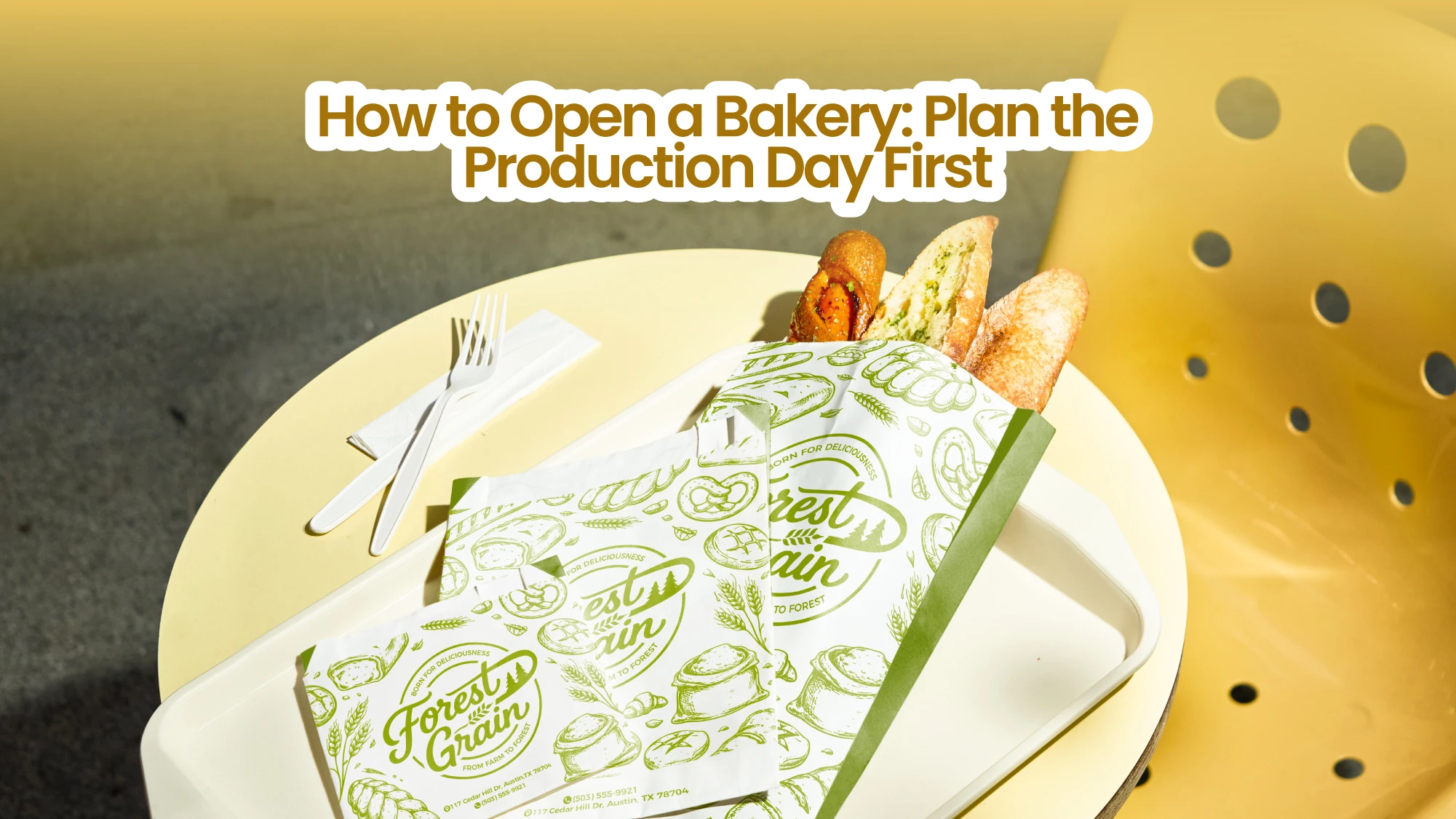
Baked goods have a shorter shelf life than almost anything else sold in food retail, and packaging is one of the few levers on it. A greaseproof-lined bag holds a pastry without staining through. Boxed cakes travel. A window bag lets a customer see the product, which matters when the product is the display.
Two practical points for a first order. Custom printed packaging is manufactured to order rather than pulled from stock. At Fusenpack it runs 10 to 12 weeks depending on complexity and quantity, so it belongs on the same schedule as the oven rather than after it. And tooling is retained for reorders with no plate fee on a repeat run, which rewards settling the artwork before the first order rather than iterating across several. Our guide to custom bakery bags covers window types and grease resistance in detail.
Your First Ninety Days After You Open a Bakery
- Decide the format, whether retail, wholesale, cottage, or a deliberate mix, before viewing any premises.
- Write the production day out hour by hour for your intended product range, including who is present at each hour.
- Cost a single trading day at three demand levels: a good day, an average day, and a quiet one. The quiet one is the test.
- Check your state’s cottage food rules if you intend to start from home, including product restrictions, sales limits and labelling.
- Call the health jurisdiction about plan review timing and whether wholesale changes your permit category.
- Size the oven and proofing to the peak batch, then size cooling and racking to match, then find premises that fit all three.
- Order custom packaging at the same time as the equipment, allowing for the manufacturing lead time.
- Start weighing waste on day one, by product, at close. Adjust production weekly against what the scale says rather than what the day felt like.
Step eight is the one that separates bakeries that reach a second year from those that do not. Baking is a craft, but running a bakery is mostly forecasting, and a forecast only improves where somebody is recording how far off the last one was.
Frequently Asked Questions
How much does it cost to open a bakery?
The cost of opening a bakery depends far more on format than on brand or menu. A cottage operation working from a permitted home kitchen carries almost no premises cost. Wholesale bakeries need a production unit but no shopfront. A retail bakery, meanwhile, carries the highest fixed cost of the three because it pays retail rent. Decide the format first, then cost the premises, equipment and opening stock against that specific model rather than against a published average.
Do I need a commercial kitchen to start a bakery?
Not necessarily at the outset. Most states permit certain baked goods to be produced in a domestic kitchen under a cottage food law. Limits usually cover what may be made, where it may be sold and how much may be earned annually, and mandatory labelling. Those limits are set by statute and vary by state, so confirm your own before assuming a product qualifies.
What is the difference between a retail and a wholesale bakery?
The difference is when demand becomes known. A wholesale bakery bakes against orders placed in advance, so its waste exposure is low and its cash is tied up in invoices paid on terms. A retail bakery bakes on a forecast made the night before, carries the unsold stock as loss, and is paid at the till. Many bakeries run both because wholesale orders absorb the fixed cost of firing the oven.
How much waste should a bakery expect?
A peer-reviewed mass-balance study of five Polish businesses measured daily losses between 9.7 and 14.4 percent of production volume, with fresh pastry ranging much more widely than bread. That is directional for the category rather than a benchmark, since it covers five businesses in one country over seven days. The same study found measured losses roughly five times higher than the same operators’ survey estimates, which is the more transferable finding: operators underestimate waste until they weigh it.
What equipment does a small bakery need first?
Size the oven and proofing capacity to the peak batch rather than the daily total. Then provide cooling and racking space to match, because product occupies floor area between the oven and the shelf for longer than most plans allow. Equipment must also meet the certification your health jurisdiction requires, which is a separate constraint from capacity.
How long does it take to open a bakery from scratch?
The controlling factor is usually plan review and permitting rather than construction, since many jurisdictions require health department approval of plans before building work starts. Add the manufacturing lead time for anything made to order, including custom packaging, which runs 10 to 12 weeks at Fusenpack depending on complexity and quantity.
Sources: Magnitude, Causes and Scope for Reducing Food Losses in the Baking and Confectionery Industry, Agriculture 2021, 11(10), 936, accessed September 2026. Loss figures are from five businesses in Poland measured over seven days and are directional for the category rather than a benchmark for any individual bakery. Cottage food rules, permit categories and plan review requirements are set by state and local jurisdictions and vary; confirm yours before committing to a format.
How this article was produced. Fusenpack drafted and structured this guide with AI assistance and generated the timeline diagram above as an illustration. It was reviewed before publication by the Fusenpack technical team against the study and guidance cited. The loss figures come from the named peer-reviewed source with its sample and method stated, and packaging lead times and order quantities come from Fusenpack’s own production records.