Custom Food Packaging: A Buyer’s Guide to Materials, MOQ, and Lead Time
By
Contents
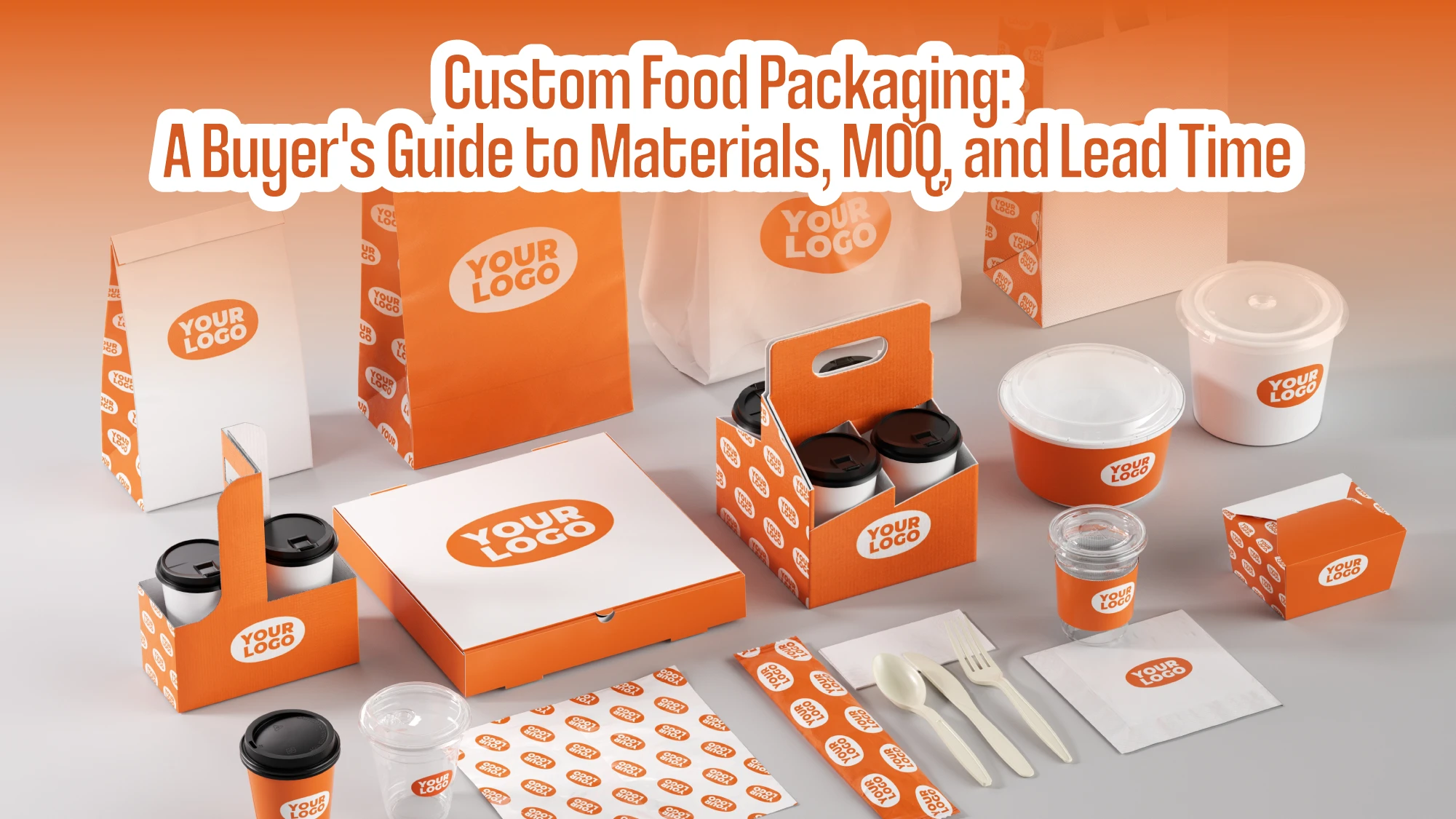
A first custom food packaging quote almost never comes back looking like the request that generated it. You asked for a box with your logo on it. What arrives is a document referencing a print process you have not heard of, a minimum four times higher than the number in your head, and a question about whether your sauce counts as a fatty food under federal rules. Nothing there is a red flag. It is simply the part of sourcing that suppliers assume you already know.
Everything on that quote traces back to three things: the material your food actually requires, whatever is inflating your minimum order, and how the calendar stacks from artwork approval to delivered pallets. Compliance runs underneath all three. Below, each one is separated out, along with the documentation worth insisting on in writing rather than accepting as a reassuring line in an email.
Start Here: The Three Decisions
Choose the material from how your food behaves, not from how the box looks. Hot and greasy items need a barrier that survives oil and steam. Cold and wet items need rigidity and a lid that seals. Once the material is fixed, your minimum order follows from the print method. Plates and cutting dies are one-time tooling costs, and they have to be spread across a run. Digital printing carries almost no tooling, so small orders stay viable. Flexo and offset need physical plates, which is why unit price collapses at volume and why suppliers quote a floor. Lead time then stacks in sequence: artwork approval, a physical pre-production sample, the production run itself, and transit. Compliance sits underneath all of it. Ask for the food-contact documentation and the PFAS certificate before you approve artwork, not after the pallets land.
What Each Decision Controls on the Quote
| Decision | What it drives | What buyers get wrong |
|---|---|---|
| Material and barrier | Whether the pack survives the food, and which regulations apply | Picking by appearance, then discovering grease strike-through in week two |
| Print method | Minimum order quantity and how fast unit cost drops | Assuming MOQ is a policy rather than a tooling math problem |
| Structure and tooling | Whether a repeat order is cheaper than the first one | Not asking who owns the die after the first run |
| Certification evidence | Whether you can legally sell in states with PFAS restrictions | Accepting a marketing claim instead of a lab result |
| Sampling stage | How much of the timeline is inside your control | Treating artwork sign-off as instant when it is usually the slowest step |
Before going deeper, it helps to know where this article sits. This page is the entry point for the whole custom range. For format-specific detail, work outward to custom takeout boxes, custom takeout bags, and custom to-go containers. If you are outfitting a venue rather than sourcing one item, the custom restaurant packaging guide sequences the order for you.
Start With the Material, Not the Shape
Most sourcing mistakes trace back to a material chosen for looks. A kraft box photographs beautifully and then fails the moment it holds a braise for twenty minutes in a delivery bag. Heat, fat, and moisture attack packaging in different ways. So the honest starting question is what your worst-case item does to a container. Not what your best seller looks like next to it.
Which food packaging materials belong on your shortlist
The field narrows quickly. Solid bleached and kraft paperboard handle dry to moderately greasy items, and both print well. Corrugated adds crush resistance for stacked delivery. Molded fiber gives you rigidity and a compostable story in one part, though it needs a coating decision for wet food. Plastic still wins where you need a visible product, a tight seal, or freezer tolerance. Coatings and laminations sit on top of all of these, and they are where most of the regulatory questions live. Compare food packaging materials on grease resistance and heat tolerance first. Price comes second. That order tends to produce a shortlist of two rather than a catalogue of twelve.
Food grade bags for food packaging and when paper beats film
Bags follow the same logic on a smaller scale. Food grade bags for food packaging split roughly three ways. Greaseproof paper suits fried and baked goods. Laminated or coated paper adds a moisture barrier. Film wins where shelf life matters more than presentation. Since paper takes print better and reads as premium, many operators default to it. If your product needs to stay crisp for two hours or sealed for two weeks, paper alone will not carry it. At that point a coating or liner enters the conversation.
Biodegradable food packaging and what the label has to prove
Claims are where the sourcing conversation gets slippery. Biodegradable food packaging is not a regulated phrase on its own. So the useful question is which standard a product was tested against. For items marketed as compostable in commercial facilities, the relevant specification is ASTM D6400. It covers labeling of plastics designed to be aerobically composted in municipal or industrial facilities. Certification bodies then sit on top of that. The Biodegradable Products Institute, for example, additionally caps fluorinated chemicals in anything it certifies.
| Layer | Requirement | Threshold or scope | In force since |
|---|---|---|---|
| Test standard | ASTM D6400 | Labeling of plastics designed to be aerobically composted in municipal or industrial facilities | Current edition, references ISO 17088 |
| Fluorine cap | BPI certification limit | Maximum 100 ppm total organic fluorine, BPI-approved lab result required | 1 January 2020 |
| Documentation | BPI certification limit | Ingredient safety data sheets plus signed statement of no intentionally added fluorinated chemicals | 1 January 2020 |
Sustainable food packaging means the material actually breaks down, composts, or recycles once it leaves your kitchen, not just what the label says. The same question applies to the burger and clamshell category. Buyers hunting specifically for eco-friendly food packaging should ask suppliers for certification details rather than relying on the word “eco” alone.
What Actually Sets Your Custom Food Packaging MOQ
Minimum order quantity is rarely arbitrary, although it often feels that way when a quote comes back. It is the point where fixed setup costs spread across enough units to make the job worth running. The fastest way to move an MOQ is to change what creates the setup cost in the first place.
Custom food boxes and the tooling that comes with them
A custom structure needs a cutting die, and that die is a physical object someone has to make. Printing adds its own setup. Digital presses carry no plates, so short runs stay economical and MOQs sit low. Flexographic and offset printing require plates per colour. That is why they get dramatically cheaper per unit at volume, and why suppliers set a floor beneath which the job loses money. Custom food boxes in a stock size with digital print behave one way on a quote. The same design cut to a bespoke footprint with four-colour offset behaves completely differently.
Ask who keeps the die after run one. When tooling is retained and reused, your second order should not repeat the first order’s setup charge. That single question changes the economics of a repeat program more than most negotiation over unit price.
Custom fast food packaging on a multi-item menu
Multi-item programs create a trap. If every SKU gets its own bespoke structure, you are buying a separate tooling and setup event for each one. Each carries its own floor.
Consolidating SKUs to Lower the Floor
A shared shell with printed variation consolidates volume into fewer runs. So does a small set of sizes that stretch across several menu items. That is the practical route to affordable custom fast food packaging without dropping to generic stock. Operators sourcing fast food packaging across a franchise network usually land on three or four structures rather than nine.
| Lever | Pushes MOQ down | Pushes MOQ up |
|---|---|---|
| Print method | Digital, no plates required | Flexo or offset, plates per colour |
| Structure | Existing die or stock footprint | Bespoke die cut to a new footprint |
| Colour count | One or two colours | Full process plus spot colours |
| Finishing | None or a single coating | Foil, emboss, window patching, specialty lamination |
| SKU spread | Shared shell across menu items | Unique structure per item |
| Material | Widely stocked board grades | Specialty or certified stock ordered to run |
Published MOQ figures vary widely. A food packaging company running digital short-run work quotes very differently from one geared to long offset runs. Treat any single number as a starting point, not an industry constant. Get it quoted against your actual structure, colour count, and finishing before you plan inventory around it. For side-by-side comparison, our roundup of food packaging companies covers how the larger food packaging suppliers position on volume, and it remains the better page for anyone evaluating a food packaging supplier, food packaging manufacturers, or food service packaging manufacturers against each other. Buyers focused purely on cost per unit should start with our breakdown of affordable food packaging instead.
Lead Time, Sampling, and the Parts Buyers Underestimate
Lead time is a sequence, not a single number. The slowest stage is usually the one on your side of the table. Artwork rarely clears in one pass. Dielines get returned because bleed is missing, a logo sits across a fold, or legally required text was never supplied. Production cannot start until artwork is locked. So every revision round moves the delivery date by more than the revision itself took.
Custom restaurant packaging for a first order
After artwork, a pre-production sample is the checkpoint worth insisting on. A flat proof shows colour. A physical sample shows whether the lid seats, whether the board creases cleanly, and whether the print survives folding. For custom restaurant packaging especially, load the sample with the actual product before approving it. A container that passes an empty inspection can still fail under a hot, heavy portion. Once the sample is signed off, production and transit are the predictable stages. Imported goods add a shipping-mode decision that changes the tail of the schedule considerably.
Where compliance enters the timeline
Compliance documentation is easiest to obtain before you approve artwork and hardest to obtain after a shipment has been rejected. For paper and paperboard touching aqueous and fatty foods, the governing federal regulation is 21 CFR 176.170, which sets out which substances may safely be used in the food-contact surface and ties compliance to extractives limits organised by food type and condition of use.
| Food type (21 CFR 176.170) | Dry | Aqueous | Fatty | Conditions of use referenced |
|---|---|---|---|---|
| Types I to VII (aqueous and fatty groupings) | — | Applies | Applies | A through H |
| Type VIII (dry foods) | Applies | — | — | A through H |
| Type IX | — | Applies | Applies | A through H |
State law then adds a second layer that federal compliance does not cover.
State-Level PFAS Rules
Washington restricts intentionally added PFAS in paper and plant-fibre food packaging under RCW 70A.222.070, phased in by product category, and requires manufacturers to keep a certificate of compliance on file during use and for three years after final distribution.
| Phase | Effective date | Categories covered |
|---|---|---|
| Phase 1 | 1 February 2023 | Wraps, plates, food boats, pizza boxes |
| Phase 2 | 1 May 2024 | Bags and sleeves, bowls, flat serviceware including plates and trays, open-top containers such as french fry cartons and food cups, closed containers such as clamshells |
Full details of the restricted categories and the certificate requirement are published by the Washington State Department of Ecology, and the fluorinated-chemical limit behind most compostable certifications is documented by BPI. These rules differ by state, and they continue to expand. Confirm the requirements for every state you ship into. Do not assume one certificate covers the country.
Putting It Together for a First Order
A workable first order tends to look conservative on structure and ambitious on documentation. Keep the format count low so volume consolidates into fewer runs. Lock the material against your worst-case item, not your prettiest one. Spend the negotiating energy on tooling ownership, the pre-production sample, and the compliance file. Shaving cents off a unit price matters less, since you will renegotiate it at volume anyway.
Presentation still earns its place in the budget, and there is a real commercial case for it; our page on the marketing benefits of custom food packaging covers what branded packaging returns beyond containment. It just belongs second in the sequence. Packaging that photographs well and leaks costs more to fix than packaging that holds and prints plainly.
For the remaining formats in the range, see custom printed cups for beverage programs and greaseproof paper for food for the barrier layer that sits underneath most fried and baked items. Together with the format pages linked earlier, they cover the majority of what a food packaging for restaurants program needs in year one.
Frequently Asked Questions
How do I know which material my product needs?
Test against your worst-case item rather than your bestseller. Identify the hottest, greasiest, or wettest thing you sell. Then choose the barrier that survives it for the longest realistic delivery time. Everything lighter on the menu will be comfortably covered by that choice.
Why is the minimum order quantity so high for my design?
Usually because of tooling and plate setup. A bespoke cutting die plus multi-colour offset or flexo printing creates fixed costs. Those only make sense across a larger run. Switching to digital print, an existing die, or fewer colours typically brings the floor down substantially.
Is biodegradable food packaging the same as compostable?
No. Biodegradable is not a regulated term on its own. Compostable claims are normally tied to a test standard such as ASTM D6400, and to a certification scheme that verifies it. Ask which standard the product was tested against and who issued the certificate.
What documentation should I request before approving an order?
Request the food-contact compliance documentation covering your specific food type and condition of use under 21 CFR 176.170, a PFAS certificate of compliance for the states you ship into, and, if the product is marketed as compostable, the certification record including the fluorine test result.
Do I get to keep the cutting die after my first order?
That depends entirely on the supplier, which is why it belongs in the first conversation rather than the second. When tooling is retained and reused for you, repeat orders avoid a second setup charge. The economics of an ongoing program improve noticeably.
How far ahead should I place a reorder?
Work backwards from the full sequence: artwork confirmation, sample approval if anything changed, production, and transit. Imported shipments add a shipping-mode decision on top. So reorder while you still hold enough stock to absorb one full revision round.
Where to Take This Next
Sourcing custom food packaging gets easier once it stops being a design purchase and becomes a sequence. The material decides whether the pack survives your food at all. That is why it has to be settled before anything else. Print method and tooling then set what you can realistically afford to order. The compliance file decides where you are allowed to sell it. Buyers who work through those in order usually get a usable first run, and a noticeably cheaper second one. Buyers who start from the mockup tend to pay to learn the same sequence backwards.
Want a format-by-format walkthrough next? The linked pages above go deeper on boxes, bags, containers, and cups than a single guide reasonably can.