What is Sustainable Food Packaging? Key Concepts And Practices
By
Contents
- Start Here: What the Word Has to Mean Before It Means Anything
- Sustainable Food Packaging Materials Compared
- Which Claims Have a Standard Behind Them
- Food-Contact Compliance Still Applies
- How to Switch Without Breaking Service
- What It Costs, Honestly
- Where to Go by Format
- Frequently Asked Questions
- Where This Leaves a Buyer
“Sustainable” is the least regulated word in packaging. No federal rule defines it, so a supplier can print it on a laminated pouch that no facility in your state will accept. The words that do carry a fixed meaning are compostable, recyclable and PFAS-free, and each of them is tied to a specific test or statute you can ask to see.
This guide sorts the category by what a buyer can actually verify: which materials do what, which claims have a standard behind them, what the state PFAS rules now require in writing, and where the cost difference really sits.
Start Here: What the Word Has to Mean Before It Means Anything
A packaging item earns the description through one of three routes, and they are not interchangeable. It composts in a facility that exists near your customers. It recycles in a stream that accepts that material. Or it uses meaningfully less material to begin with. A pack can satisfy one route and fail the other two, which is why “eco-friendly” on a spec sheet is a starting question rather than an answer.
The practical test is simple. Ask which standard the claim was measured against, who issued the certificate, and which states the compliance file covers. A supplier who can answer all three is describing a property. One who cannot is describing a preference.
Sustainable Food Packaging Materials Compared
| Material | End-of-life route | Holds up against | Where it fails |
|---|---|---|---|
| Kraft and uncoated paperboard | Recyclable, often compostable | Dry and lightly greasy food, print quality | Free liquid and sustained grease strike through it |
| Molded fiber (bagasse, bamboo pulp) | Compostable where a facility accepts it | Rigidity, heat, a genuine compostable claim | Needs its own coating decision for anything wet |
| Non-fluorinated barrier coatings | Varies by formulation | Grease resistance without PFAS | Softens under sustained heat more readily than the fluorochemical treatment it replaced |
| PLA and plant-based plastics | Industrial composting only | Clarity, cold-drink service | Low heat tolerance; landfill where no industrial facility exists |
| Aluminium | Widely recycled | Complete light and oxygen barrier, long shelf life | Contents not visible; higher unit cost at low volume |
| Glass | Widely recycled, reusable | Premium presentation, inert | Weight and breakage make it wrong for delivery |
| PE or poly lamination | Neither compostable nor easily recycled | Near-absolute grease and moisture barrier | Rules out both end-of-life routes |
Two rows in that table decide most orders. Molded fiber and non-fluorinated coatings are where the market moved after the PFAS restrictions, and both trade some performance for compliance. Buyers coming from a laminated or fluorochemical-treated stock should expect to re-test rather than assume equivalence. Our guide to greaseproof paper coatings covers how far each route gets on the grease-resistance scale.
Which Claims Have a Standard Behind Them
Three of the words in circulation are measurable. The rest are marketing.
Compostable
For items marketed as compostable in municipal or industrial facilities, the specification most claims are measured against is ASTM D6400. Certification sits on top of the standard. The Biodegradable Products Institute caps total organic fluorine at 100 ppm in anything it certifies, demonstrated by an approved lab result, a requirement effective since 1 January 2020. Ask which standard the product was tested against and who issued the certificate.
Biodegradable
Not a regulated term on its own. Almost everything breaks down eventually; the question is under what conditions and in what timeframe. Treat an unqualified “biodegradable” claim as unverified until it names a test.
PFAS-free
This one now has legal weight. Several states restrict intentionally added PFAS in paper and plant-fibre food packaging. Washington’s phased restriction under RCW 70A.222.070 covered wraps, plates, food boats and pizza boxes from 1 February 2023, then bags, sleeves, bowls, flat serviceware, open-top containers and closed containers from 1 May 2024. Manufacturers must keep a certificate of compliance on file during use and for three years after final distribution.
Scopes and dates differ between states, so one certificate does not automatically cover national distribution. Request documentation for every state you ship into.
Food-Contact Compliance Still Applies
Sustainability sits on top of food safety, not instead of it. For paper and paperboard components touching aqueous and fatty foods, the governing federal regulation is 21 CFR 176.170, which ties compliance to extractives limits organised by food type and condition of use. Condition of use is part of the rule rather than a footnote, so state your temperature and contact time when you ask for documentation.
How to Switch Without Breaking Service
Operators who change everything at once usually reverse at least one decision. A sequence works better.
| Stage | What to change | Why this order |
|---|---|---|
| 1. Easiest wins | Bags, wraps, napkins, carriers | Low performance risk, and paper alternatives already dominate these formats |
| 2. Test under load | The primary hot container | This is where compostable materials most often disappoint. Sample with your own worst-case dish before committing. |
| 3. Beverage side | Cups, lids, straws | PLA behaves differently in hot service than in cold; decide per drink rather than per range |
| 4. Last | Anything requiring a genuine liquid seal | Seal integrity is the hardest property to hold while dropping a plastic barrier |
Two practical notes. Compostable only works if a facility near your customers accepts it, so check local acceptance before building the claim into your brand story. And a compostable item in a mixed bin is landfill, which is why customer-facing labelling matters as much as the material.
What It Costs, Honestly
Sustainable formats generally carry a higher unit price than their conventional equivalents, and the gap narrows with volume rather than disappearing. The variables that move the number are the same ones that move any packaging quote: print method, colour count, whether the structure needs new tooling, and order quantity.
Tooling is the part worth planning around. When a supplier retains the die or mold for a repeat of the same specification, the setup cost lands once rather than every order. That makes it cheaper over a year to settle a format early and reorder it than to keep adjusting the spec while testing alternatives. Our custom food packaging buyer’s guide works through how material, quantity and print interact on a quote.
Where to Go by Format
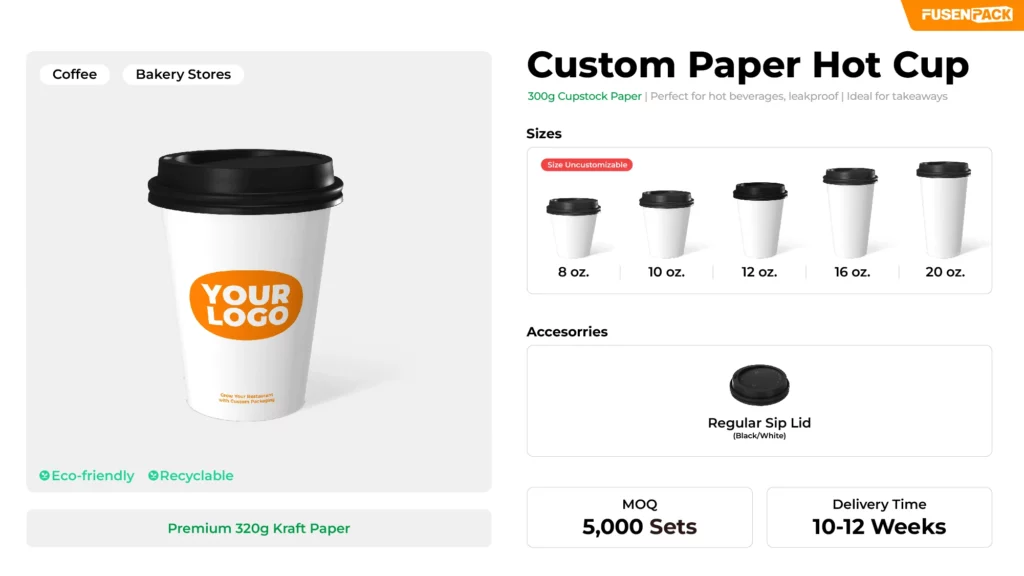
The material decision changes by format, so the format guides go deeper than a general page can. For containers, custom to-go containers covers material against food temperature and moisture. For carriers, custom takeout bags covers paper weight and coating. For the beverage side, custom printed cups and custom paper straws cover the compostable-claim questions specific to each.
Frequently Asked Questions
Is biodegradable the same as compostable?
No. Biodegradable is not a regulated term on its own, whereas compostable claims are normally tied to a test standard such as ASTM D6400 and to a certification scheme that verifies it. Ask which standard the product was tested against and who issued the certificate.
Does sustainable packaging cost more?
Usually yes per unit, and the gap narrows with volume rather than closing. Print method, colour count and tooling move the number more than the base material does, so compare quotes on the same structure and colour count rather than on material alone.
Do I need PFAS documentation?
If you ship into a state with a restriction on fibre-based food packaging, yes. Washington requires manufacturers to keep a certificate of compliance on file during use and for three years afterwards. Scopes and dates differ between states, so request documentation covering each state you distribute in.
Will compostable packaging actually get composted?
Only where a facility accepting it operates near your customers. In a region without that infrastructure a certified compostable item ends up in landfill alongside conventional packaging, which is worth knowing before the claim becomes part of your brand story.
Which format should I switch first?
Bags, wraps and carriers. They carry the lowest performance risk and paper alternatives already dominate those formats. Leave anything needing a genuine liquid seal until last, because seal integrity is the hardest property to hold while dropping a plastic barrier.
Where This Leaves a Buyer
Sustainable food packaging is workable as a specification and unhelpful as an adjective. Decide which end-of-life route you are actually buying, ask for the standard and the certificate that back it, hold the PFAS compliance file for every state you ship into, and switch formats in an order that puts the riskiest one last. A supplier who answers those questions in writing is selling you a property. One who answers with adjectives is selling you a preference.
Reviewed by the Fusenpack packaging engineering team, September 2026. Regulations and standard revisions change; the state rules and specifications cited here were checked against their issuing bodies on 9 September 2026. Confirm current requirements for your own ship-to states before ordering.