Leak Proof Soup Container Design: Why Most Soup Containers Fail in Delivery
By
Contents
- The “Leak-Proof” Label Means Less Than You Think
- 4 Reasons Soup Containers Actually Leak
- The Lid Seal: Where Most Failures Start
- Why PP Beats Paper for Hot Soup
- Delivery Conditions Are Harder Than You Think
- Steam Pressure: The Hidden Failure Point
- Structure: The Factor Nobody Checks
- Leak-Proof Is a System, Not a Feature
- Matching the Container to Your Setup
- Test Before You Buy in Bulk
- Most Leaks Are Operational, Not Manufacturing
- When a Different System Makes More Sense
- Bottom Line
- FAQ
Getting leak proof soup container design right isn’t about finding a better lid. It’s about understanding that the seal, the material, the structure, and the way you fill it are a single system — and one weak link breaks the whole thing.
The “Leak-Proof” Label Means Less Than You Think
Walk into any restaurant supply store and every container claims leak-proof construction. Drivers still show up with broth-soaked bags. Customers still leave one-star reviews. Something isn’t adding up.
The label isn’t wrong — it’s just narrow. Leak-proof means it passed a controlled test, sitting still. A 45-minute delivery on a scooter is not a controlled test. The container that held fine in the warehouse can fail completely before it reaches the customer.
Leak-proof is conditional. Once you understand the conditions, the fix becomes obvious.
4 Reasons Soup Containers Actually Leak
Before blaming the supplier, identify which failure mode you’re actually dealing with:
- Gap leakage — tiny gaps between lid and rim that let liquid sneak through under pressure
- Material warping — hot soup above 85°C softens certain containers, deforming the seal geometry
- Steam pressure — liquid above 80°C produces vapor that pushes against the lid from inside
- Transit impact — every hard stop sends liquid slamming into the seal
Each failure has a specific fix. The problem is that most buyers treat “leak-proof” as a binary — either a container has it or it doesn’t — rather than a set of engineering tradeoffs that need to be managed together.
The Lid Seal: Where Most Failures Start
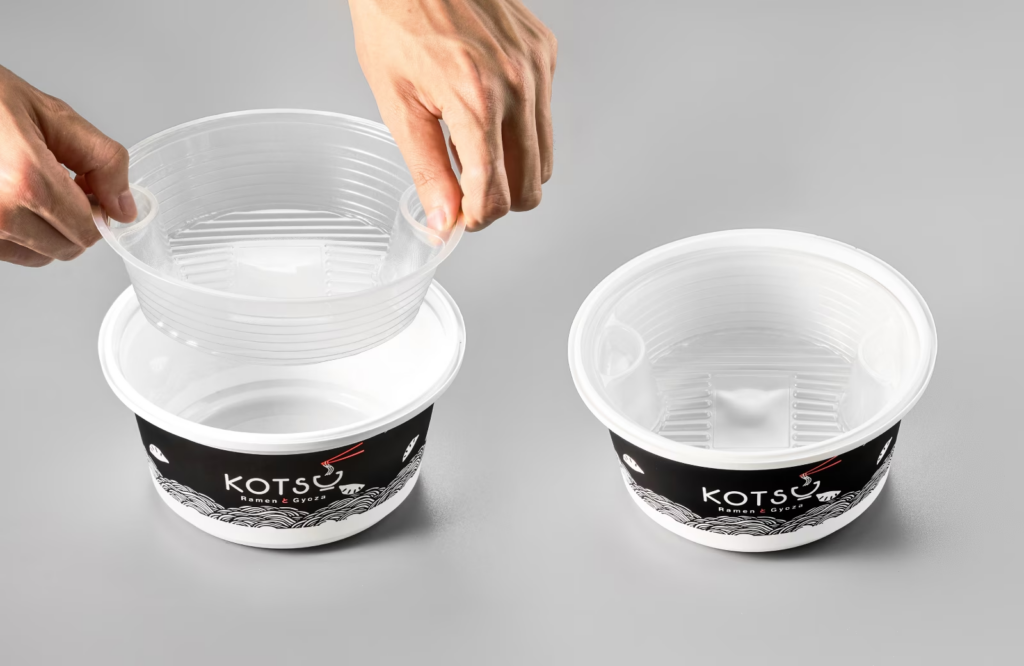
A lid sitting on a rim isn’t sealing anything. What actually holds is compression — the lid pressing a groove or gasket tight against the container rim. Without that mechanical contact, internal pressure finds a path out.
| Lid Type | Seal Strength | Delivery-Ready? | Notes |
| Snap-fit with groove | High | Yes | Best all-around for transit |
| Screw-top | Very High | Yes | Slower to open |
| Film/heat-seal | Medium | Conditionally | Reliable only in static conditions |
After forty minutes of movement, a flat-edge lid and a grooved-rim lid are not the same product. Snap-fit designs with a sealing rim maintain compression through vibration; flat-edge lids rely on surface contact that degrades the moment the bag tilts.
Why PP Beats Paper for Hot Soup
Paper containers photograph well. In practice, once hot soup sits in one for twenty minutes, the walls soften, the base sags, and the lid seal distorts. Fiber containers behave the same way above 70°C.
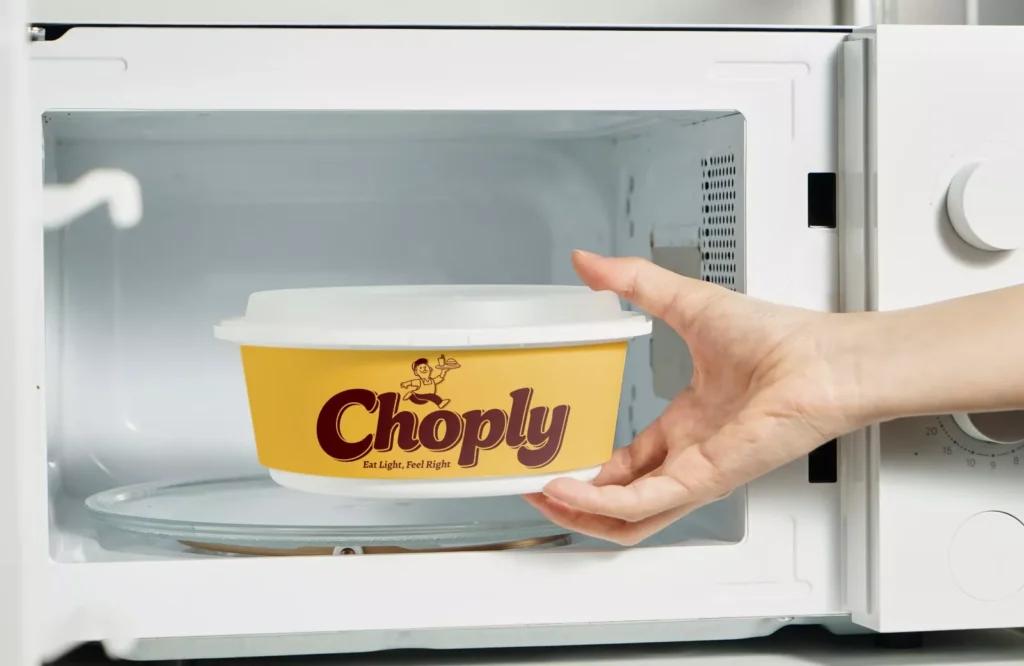
Polypropylene (PP) holds its shape across a temperature range of -10°C to 110°C. It doesn’t warp during hot filling or microwave reheating — and that dimensional stability is what keeps the seal intact through a delivery route.
| Material | Hot Soup Performance | Seal Reliability |
| PP | Stays rigid to 110°C | Consistent |
| Paper/fiber | Degrades above 70°C | Unreliable |
| PET | Rigid, but not heat-tolerant | Fails with hot liquid |
If the container warps, the seal fails. Material choice isn’t a branding decision — it’s a structural one.
Delivery Conditions Are Harder Than You Think
Lab tests don’t replicate real delivery. A container sitting still on a bench is not a container tilted sideways under three other bags for forty-five minutes in summer heat.
A 2019 study in Packaging Technology and Science found that internal pressure inside food containers during delivery increases by 15–40% from thermal expansion and physical impact combined. A sixty-minute route hits twice as many bumps as a thirty-minute one — and every hit is another stress cycle on a seal that wasn’t designed for it.
Steam Pressure: The Hidden Failure Point
The better your lid seal, the more pressure builds up inside. Steam from hot soup has nowhere to go, so it pushes against whatever it can find — lid edges, base seams, sidewall joints.
That’s why some containers don’t leak at the top. They leak at the bottom instead.
The fix is a micro-vent built into the lid — a small pressure release that doesn’t compromise the main seal. Without it, you’re choosing between a container that breathes and one that eventually pops. A well-designed vent solves the tradeoff; the absence of one just moves the failure point somewhere less obvious.
Structure: The Factor Nobody Checks
Everyone specifies the lid. Almost nobody specifies the container body — and that’s where pressure failures often originate.
Three structural details make a measurable difference in real delivery conditions:
- A deep sealing groove on the rim — holds the lid edge under lateral pressure
- A reinforced base — prevents the bottom from bowing outward when filled with liquid
- Straight walls — tapered walls look better stacked, but create uneven pressure distribution against the lid
A container body that flexes under load will break its own seal. No lid design compensates for a structurally weak base.
Leak-Proof Is a System, Not a Feature
This is the central point: there’s no single container that’s just “leak-proof.” What you’re actually buying is four variables that either work together or don’t:
- Lid: grooved, compression-fit, with pressure venting
- Material: PP, not paper or thin PET
- Structure: reinforced base, sealing groove, straight walls
- Usage: max 80% fill, lid fully engaged, kept upright in transit
Fix three of four and the system still fails. The leak just comes from a different place.
Matching the Container to Your Setup
Food delivery (30–60 min routes): Snap-fit PP with a grooved lid, sized to your menu — typically 24 oz to 50 oz. This is the one configuration that holds through the full range of delivery conditions.
Central kitchen / meal prep: Film-sealed PP works here. Controlled transit conditions reduce impact stress, so the tighter seal performance of snap-fit becomes less critical.
Dine-in plus takeout: Look for PP bowls that are microwave-safe and presentable enough for table service while still sealing through a short delivery run. The format needs to do two jobs at once.
Test Before You Buy in Bulk
Don’t rely on supplier specifications. Three tests tell you what you need to know:
- Inversion test — fill to 80%, seal it, flip upside down for 60 seconds over white paper. Any residue, stop there.
- Hot liquid test — fill with 85°C liquid, check for steam leakage and lid flex after 5 minutes.
- Transit simulation — put the sealed container in a bag, simulate 15 minutes of movement, check for residue.
If it fails step one, steps two and three don’t matter.
Most Leaks Are Operational, Not Manufacturing
One inconvenient reality: a significant portion of soup leaks aren’t product failures. They’re kitchen failures.
The three most common operator errors:
- Overfilling — liquid above the shoulder line contacts the seal on every tilt
- Half-snapped lids — looks closed from above, isn’t
- Lid-base mismatch — physically fits the opening, geometrically incompatible with the sealing groove
Five minutes of staff training on fill level and lid engagement fixes more leaks than a supplier change. Check your kitchen before you check your supplier.
When a Different System Makes More Sense
Sometimes the container isn’t the right lever to pull:
- Heat-seal film — good for static shipping, frustrating for customers to open
- Double-bagging — adds backup at the cost of waste and handling time
- Glass — excellent seal, completely impractical at delivery volume
For most operators, PP remains the most workable answer — not because it’s perfect, but because no other material checks all the boxes simultaneously: temperature tolerance, seal compatibility, microwave safety, and cost.
Bottom Line
Soup leaks because one link in a four-part system broke down: seal design, material, structure or packing method. Fix the root cause, and the whole system works. Picking the wrong solution only leads to constant supplier switching with no real fix.
The best soup containers are not overpriced ones. They are professionally engineered for real delivery transit and proper packing. Fusenpack’s custom plastic soup bowl with lid is built exactly for such real-world delivery scenarios.
FAQ
Q: Why does my soup container leak even though it says leak-proof? “Leak-proof” is validated under static conditions. Real delivery involves pressure fluctuations, thermal expansion, and repeated impact — conditions that most containers were never tested against.
Q: What’s the best material for hot soup delivery containers? PP. It stays dimensionally stable up to 110°C, which preserves the seal geometry through filling and reheating. Paper softens above 70°C and the seal follows.
Q: How full should I fill a soup container? 80% maximum. Above that, liquid reaches the seal on every tilt — and the bag tilts constantly.
Q: How do I test a soup container before ordering in bulk? Start with the inversion test: fill to 80%, flip upside down for 60 seconds over white paper. If it leaks, you have your answer. If it holds, move to the hot liquid and transit tests.