Salad Bowls for Delivery: Materials, Lids & How to Keep Salads Fresh
By
Contents
- Why Salad Bowl Selection Is More Complicated Than It Looks
- Why Most Salad Bowls Fail in Delivery
- A Lesson From the Road: The Greenway Kitchen Story
- Best Materials for Salad Bowls in Delivery
- Lids Are Non-Negotiable
- Sizing: Where Operators Consistently Miscalculate
- How to Keep Salad Fresh During Delivery
- Matching Bowl Type to Business Type
- Common Mistakes Worth Avoiding
- The Setup That Works for Most Operations
- FAQ
- Packaging isn’t top of mind for kitchens, yet it makes all the difference.
Salad Bowls that look great on the counter are rarely the ones that survive a 25-minute ride.
Why Salad Bowl Selection Is More Complicated Than It Looks
Most operators don’t think hard about salad bowls until something goes wrong. The assumption — that any decent container will do — tends to hold up fine for dine-in and short-radius pickup. Then the delivery radius expands, or a rainy Tuesday backs up courier times, and suddenly the packaging is the weakest link in an otherwise solid operation.
What changes in transit isn’t the food — it’s the physics. Moisture accumulates. Heat builds inside a sealed bag. Bowls shift and stack under pressure. A container designed for shelf presentation wasn’t engineered for any of that.
This guide covers materials, lids, sizing, and freshness mechanics — the variables that actually determine whether a salad arrives worth eating.
Why Most Salad Bowls Fail in Delivery
Three failure modes account for the overwhelming majority of delivery packaging complaints:
- Moisture absorption — paper walls soak through when wet greens sit against them for more than 15–20 minutes, and the bowl loses its shape before the order lands
- Lid failure — a poorly fitted lid lets dressing migrate, ruining both presentation and the bag lining
- Condensation buildup — trapped heat softens lettuce and turns anything crispy into something closer to soggy bread
The distinction that matters isn’t between an attractive bowl and a plain one. It’s between a bowl engineered for transit and one that was never tested outside a display shelf.
A Lesson From the Road: The Greenway Kitchen Story
Some packaging problems announce themselves slowly. This one arrived as a Monday morning full of refund requests.
In spring 2022, a Denver-based salad brand called Greenway Kitchen was operating well — locally sourced greens, scratch-made dressings, a lunch crowd that kept coming back. Their delivery rating sat at 4.6. Then they extended their delivery radius from 3 miles to 8 miles. The food didn’t change. The packaging couldn’t keep up.
The paper bowls that had handled short runs started failing on longer ones. Dressing soaked through the walls. Lids shifted in transit. Customers opened their bags to find collapsed containers and greens sitting in pooled lemon tahini. One review cut to the point: “Tasted like it was good once. Hard to tell.”
Their platform rating fell to 3.9 within six weeks. Refund requests tripled.
The fix wasn’t the recipe. It wasn’t the courier. Greenway’s operations manager tested four material types over two weeks and moved the entire lineup to bagasse fiber bowls with snap-on transparent lids, with dressings shifted to separate side cups. The change added roughly 11 cents per order. Within 90 days, ratings climbed back to 4.5 and refund volume dropped significantly. The side dressing cup — initially treated as an inconvenience — started showing up in positive reviews by name.
The radius changed. The packaging hadn’t. The salad paid the price.
Best Materials for Salad Bowls in Delivery
The material decision is where most purchasing goes wrong, usually because operators evaluate bowls in the hand rather than in a bag.
Paper salad bowls are cheap and easy to source. For delivery windows under 15 minutes, they’re workable. Beyond that, moisture from wet greens begins compromising the walls — and once a paper bowl softens, it doesn’t recover. They’re a low-risk option for very short routes and a genuine liability for longer ones.
Plastic salad bowls hold up structurally and, being transparent, let the product sell itself visually. The problem is twofold: eco-conscious customers notice plastic immediately, and plastic traps heat faster than fiber, accelerating wilting on routes that run past 20 minutes.
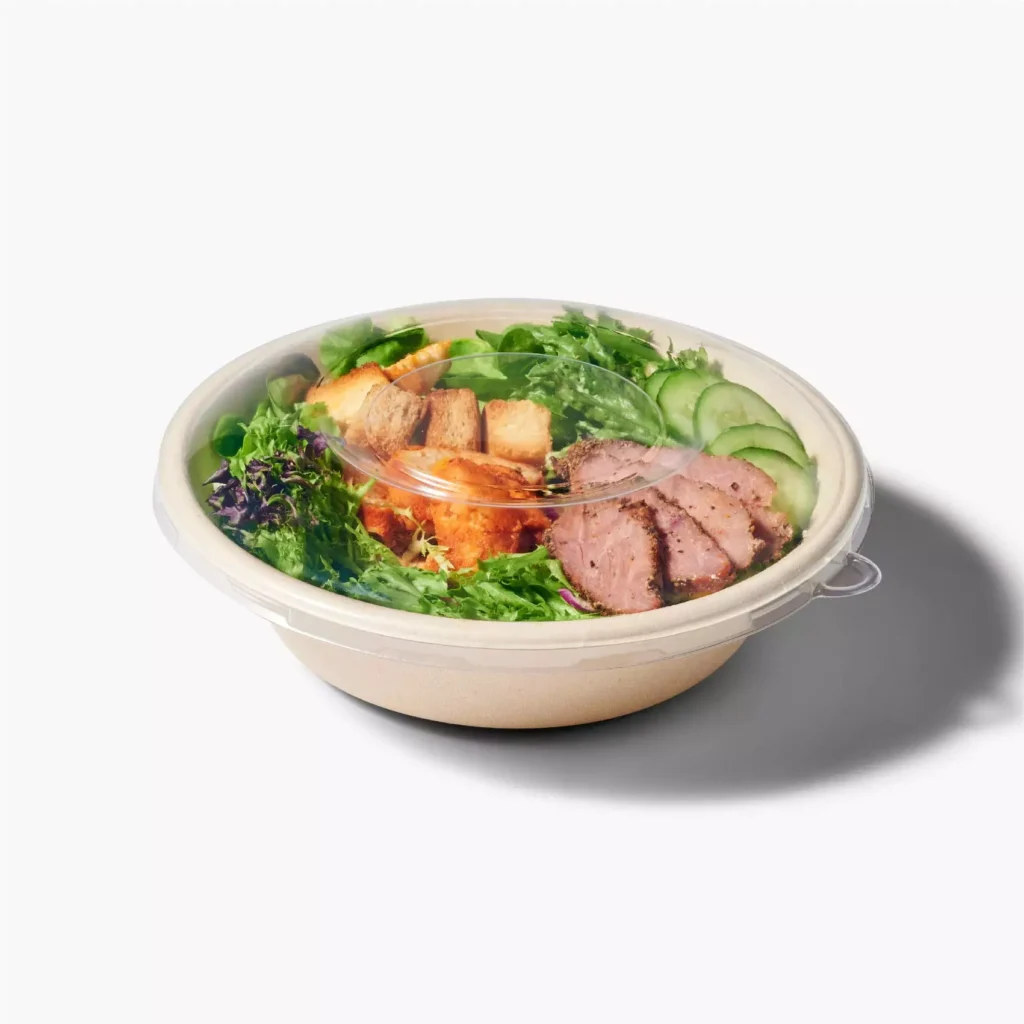
Fiber and bagasse salad bowls are the practical standard for most delivery operations. Bagasse — the fibrous material left after sugarcane juice is extracted — resists oil and moisture without chemical treatment, handles stacking pressure, and breaks down fully after use. According to the Foodservice Packaging Institute, fiber-based packaging grew over 18% in foodservice adoption between 2020 and 2023, a trend driven largely by delivery expansion. [Source: Foodservice Packaging Institute, 2023 Annual Report]
Fusenpack’s fiber bowl line is built around transit conditions specifically — wall thickness, moisture resistance, and lid compatibility calibrated for the delivery bag, not the display case.
Lids Are Non-Negotiable
Every salad going out the door for delivery needs a lid. The real question is which lid matches the build.
- Flat lids work for shallow bowls with low topping profiles
- Dome lids provide clearance for taller builds — croutons, thick proteins, whole cherry tomatoes
- Snap-on lids deliver the most secure seal, which matters most when dressing is already applied
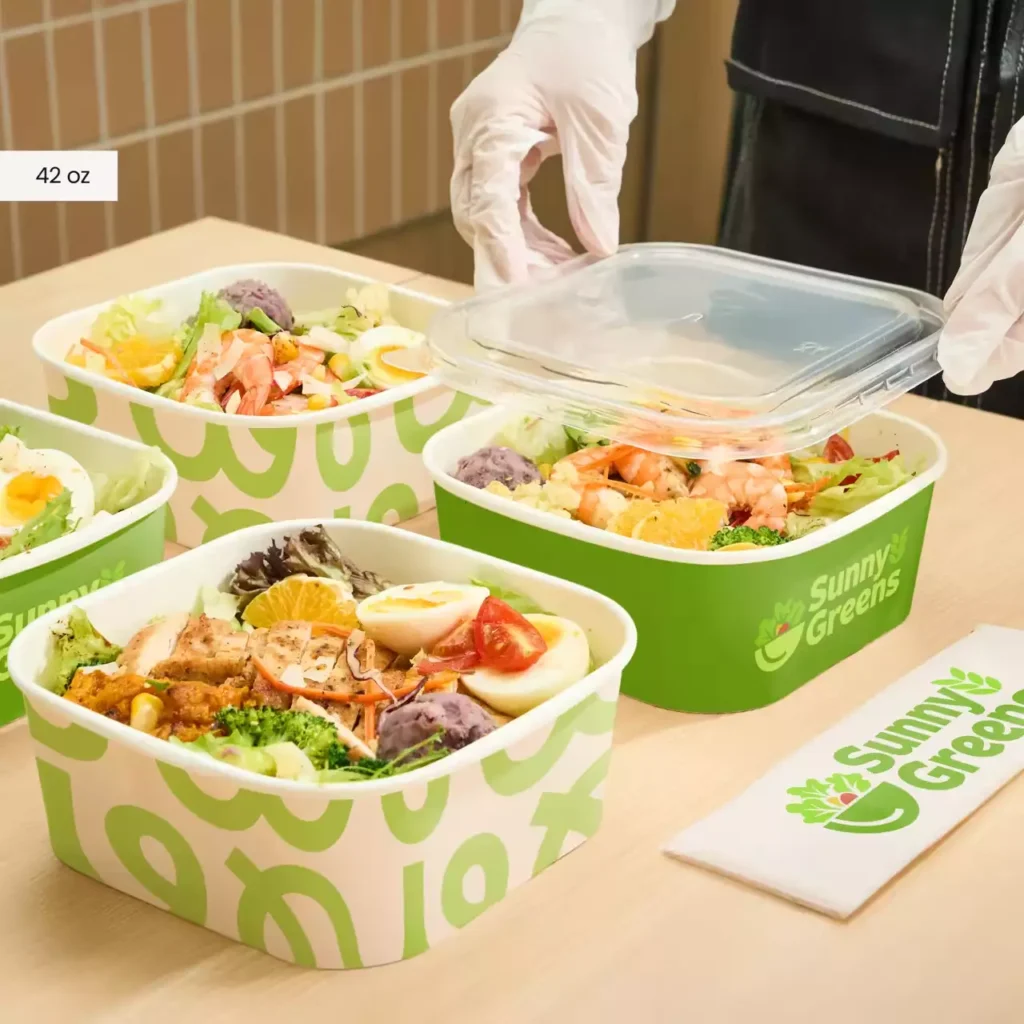
A well-fitted lid does several jobs at once: it keeps dressing from sloshing, slows condensation buildup, blocks outside odors, and creates a cleaner unboxing. Transparent lids add one more function — the customer sees what they ordered before they open it, which sets expectations at the right moment instead of after the first disappointing forkful.
Sizing: Where Operators Consistently Miscalculate
The most common sizing mistake isn’t going too small. It’s going too large and creating a seal problem.
| Size | Best Use |
| 12–16 oz | Side salad or snack portion |
| 24–32 oz | Standard single-meal serving |
| 48–64 oz | Sharing or meal prep batch |
The target fill level is around 80% capacity — enough for a generous portion, with enough headroom for the lid to seat cleanly. One regional chain that switched from 32 oz to 28 oz bowls cut leak complaints by nearly 30%, not because the bowl was better but because the lid finally had room to close. [Source: Fusenpack operator case study, 2023]
If the lid is fighting the contents to close, the bowl is too small for the build — or the build needs to be redesigned.
How to Keep Salad Fresh During Delivery
Freshness in delivery is as much a packaging problem as a culinary one. The four variables that consistently move the needle:
- Separate wet from dry — dressing in a side cup, or placed underneath the greens rather than poured on top
- Use moisture-resistant walls — fiber and bagasse outperform paper on any route over 20 minutes, and the gap widens as distance increases
- Lock the lid — snap-on closures don’t shift; loosely resting lids do
- Match material to distance — a bowl that works for a 10-minute run may not hold up for a 30-minute one. Longer routes require a higher material standard. That’s not optional.
Matching Bowl Type to Business Type
Different operations have different failure points. The packaging should match the actual risk, not just the brand aesthetic.
Cafés moving salads alongside coffee and pastry orders do well with lightweight fiber bowls and transparent dome lids — clean presentation, minimal added bulk, easy to stack.
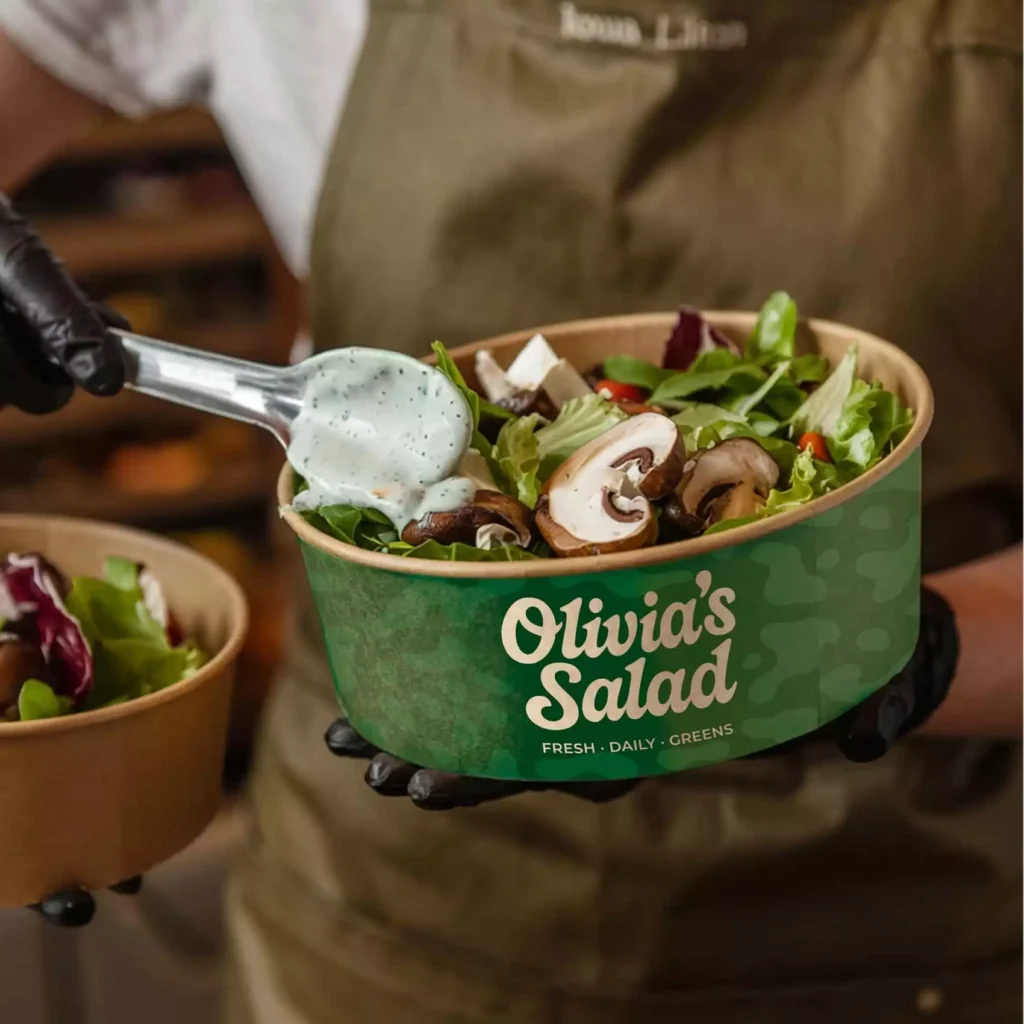
Delivery-first brands should prioritize leak resistance above everything else. A bagasse bowl with a snap-on lid and a separate dressing cup is the setup that holds its shape across longer delivery windows. Presentation matters, but it has to survive the ride first.
Premium healthy food brands are selling an experience from the moment the bag is handed over. A custom-printed bagasse bowl signals quality before the customer picks up a fork — and that impression, repeated across hundreds of orders, compounds into something customers start to associate with the brand itself.
Wholesale buyers need dimensional consistency more than any single feature. Tolerances have to hold across large runs, and MOQ flexibility matters as volume scales.
Common Mistakes Worth Avoiding
- Buying on unit price without testing transit performance — the cheapest bowl often generates the most expensive refunds
- Evaluating the bowl without evaluating the lid — fit and seal matter as much as the bowl material itself
- Sizing up “just in case” — oversized bowls create headroom that lets contents shift and lids fail to seat
- Treating packaging as overhead rather than a brand variable — customers remember the unboxing; the bowl is part of that
The Setup That Works for Most Operations
Standard delivery: 28–32 oz fiber or bagasse bowl + snap-on transparent lid + side dressing cup
Eco-focused brand: Certified compostable bagasse bowl + dome lid + custom-printed branding
High-volume wholesale: Standardized fiber bowl with verified wall thickness, sourced from a supplier who holds tolerances across large runs
FAQ
Q: What’s the best material for salad bowls used in food delivery?
A: Fiber or bagasse. Both resist moisture and oil better than paper, hold their shape under stacking pressure, and perform consistently on longer delivery routes — which is where most packaging failures actually happen.
Q: Do salad bowls need lids for delivery? Without exception.
A: A snap-on or dome lid prevents leaking, slows condensation, and keeps the presentation intact from kitchen to door. An unsealed bowl is a liability regardless of what’s inside it.
Q: What size works best for a standard single-meal salad?
A: 24–32 oz covers most full portions. Fill to around 80% capacity — generous enough to look right, with enough clearance for the lid to close cleanly. If the lid won’t seat, the portion is too large for the container.
Q: Can salad bowls be custom branded?
A: Yes. Fiber and bagasse bowls are printable, and branded packaging consistently improves customer recognition. For delivery operations in particular, the packaging is often the only physical brand touchpoint a customer experiences.
Packaging isn’t top of mind for kitchens, yet it makes all the difference.
Crews spend hours sourcing, prepping and plating meals, but packaging only gets a quick check before sealing. Delivery from shop to customer decides whether all that kitchen effort lands good reviews.
Bowls that stay firm, seal tight and keep dressings separate from greens aren’t a luxury—they’re basic necessity. Restaurants that stick to this standard keep steady ratings even as delivery zones expand.
Tired of flimsy takeout containers not built for delivery? Fusenpack’s fiber and bagasse bowls are made for real transit needs, not just shelf display.