Custom Paper Meal Prep Containers for Restaurants, Meal Prep, and Delivery Brands
By
Contents
- Why Custom Paper Meal Prep Containers Matter More Than They Look
- What Problem Does This Product Actually Solve?
- What Buyers Compare Before Choosing
- Which Food and Packaging Scenarios Decide the Right Choice?
- How to Choose the Right Size and Lid
- What Happens After Purchase: Storage, Inspection, and Reorders
- Why Customization Can Improve Sales, Not Just Appearance
- FAQ
A leaky takeout container could make you lose customers. Here’s how to choose custom paper meal prep containers that protect the food, survive the route, and make your brand look like it means business.
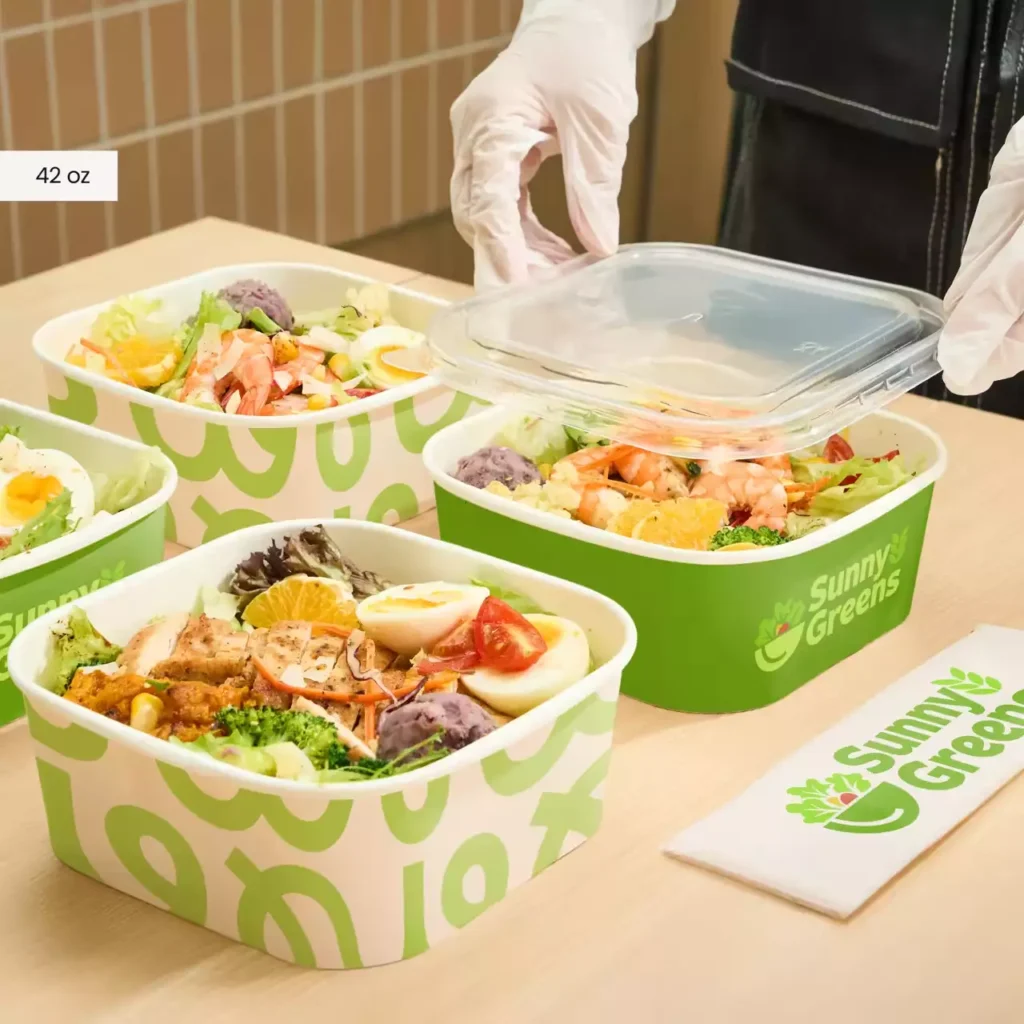
Why Custom Paper Meal Prep Containers Matter More Than They Look
Most restaurant owners put packaging as an afterthought—and that’s where problems begin. Soup leaks, lids come loose, and containers crush easily during delivery.
Custom paper meal prep containers fix the everyday issues cheap generic boxes cause.
Bad packaging brings refunds, one-star reviews, and lost repeat customers—that’s the true cost of cutting corners on your takeout boxes. Packaging sets customers’ first impression before they even take a bite.
A great meal container needs to do three things well: keep food secure, hold up through delivery, and represent your brand. Most standard store-bought options fall short on at least one of these.
What Problem Does This Product Actually Solve?
Custom paper meal prep containers address the specific failure points that frustrate both operators and customers:
- Leaking — thin or unsealed bases can’t hold sauces, dressings, or moisture-heavy foods
- Structural collapse — flimsy walls buckle under weight when stacked in delivery bags
- Lid separation — lids that don’t lock create spill risk between kitchen and doorstep
- Mixed-up orders — unlabeled generic boxes make multi-item prep chaotic
For salad shops, bowl concepts, and meal prep brands, the container is the last quality checkpoint before the customer sees the food. A well-made paper container keeps a quinoa bowl intact through 5 PM Friday traffic. A flimsy one arrives as a salad soup.
What Buyers Compare Before Choosing
Before placing an order, most buyers compare more than price. Here’s what actually separates the options:
| Factor | What to Look For |
| Material & thickness | 300–350gsm PE-coated paperboard for hot/wet food |
| Leak resistance | Double-seam base, PE or PLA lining |
| Lid type | Snap-fit, dome, or flat — depends on food height |
| Print quality | CMYK flexo or Pantone for brand-accurate color |
| MOQ | 5,000 or 10000 |
| Lead time | 8–12 weeks depending on customization complexity |
| Design support | Some suppliers charge extra; others include it free |
Two containers that look identical in a catalog photo can behave completely differently in the field. One uses a liner that softens with hot broth. The other has a lid tolerance 1mm off — just enough to pop during a multi-stop delivery run.
If you want to skip the guesswork, Fusenpack’s custom square paper meal prep container comes with food-grade grease-resistant paperboard, full-color CMYK and Pantone printing, and a free design service with 36-hour artwork turnaround — so your first sample doesn’t wait three weeks on a designer’s inbox.
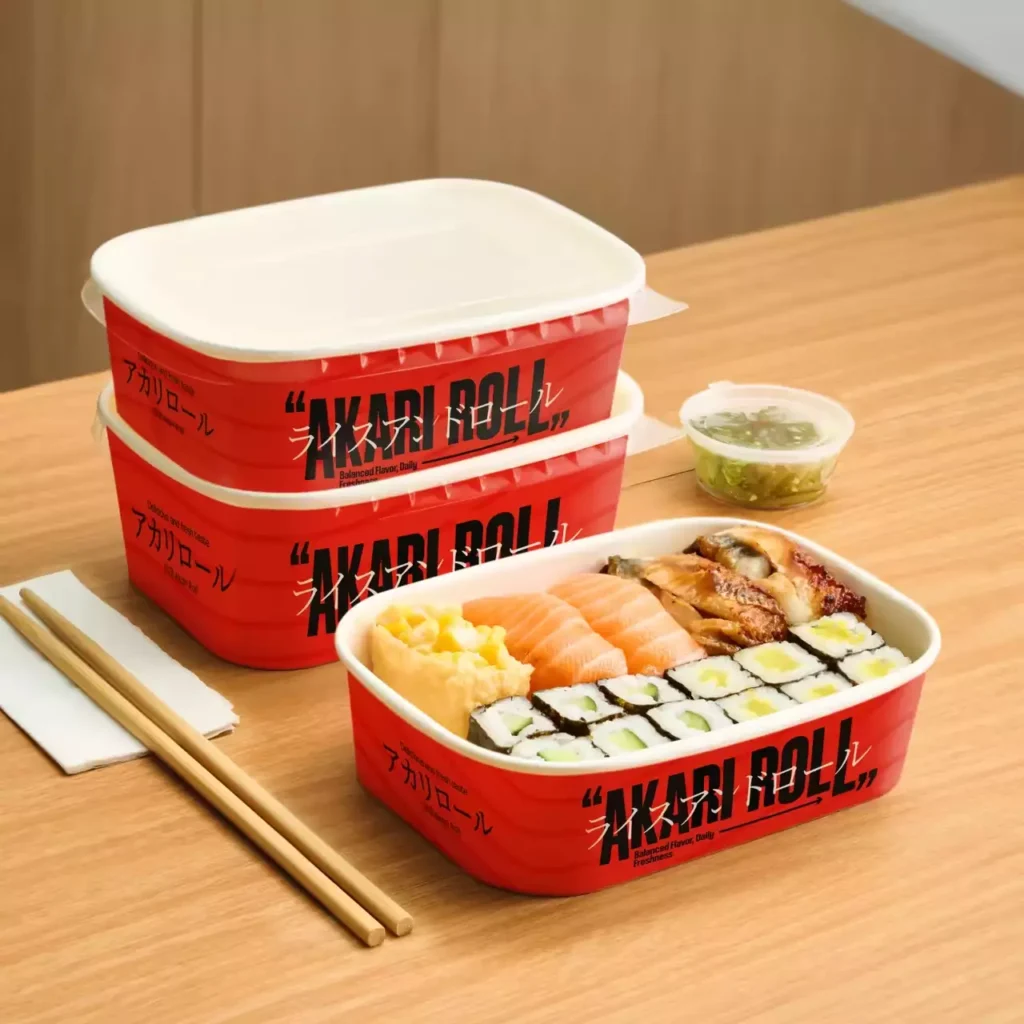
Which Food and Packaging Scenarios Decide the Right Choice?
Match the container to the dish, not the other way around. The same box that works for a grain bowl will destroy a broth-heavy ramen in transit.
1. Salad and Bowl Shops
Cold salads need ventilation to prevent condensation and sogginess. Dome lids earn their keep here — they give headroom for toppings without crushing greens flat. A 32 oz square container with a clear snap-fit lid handles most signature bowls.
2. Meal Prep and Fitness Meal Brands
Portioned meals heading into refrigerators need stackable, flat-lid designs. Leak resistance matters more than aesthetics here — these containers get stacked, jostled, reheated. If you’re marketing microwave-ready meals, specify a PE-free liner upfront; some paper liners don’t survive reheat.
3. Takeout, Delivery, and Catering
Speed of assembly is the hidden variable for high-volume delivery. Containers that nest cleanly and open fast reduce bottlenecks during the dinner rush. For catering, 48 oz trays with locking lids handle family-style portions without drama on the drive over.
4. Hot Food vs Cold Food
Hot foods need heat-resistant lining and some ventilation. Cold foods need moisture barriers. Ordering the same box for both is how you end up with soggy fries and condensation-soaked salads — a single SKU rarely serves both menus well.
5. Portion-Controlled Menu Items
Brands selling fixed macros live and die by consistency. Containers with reliable volume capacity — not just approximate size — matter when a customer is counting every gram. Fitness meal prep businesses in particular need this baked into their packaging spec from day one.
How to Choose the Right Size and Lid
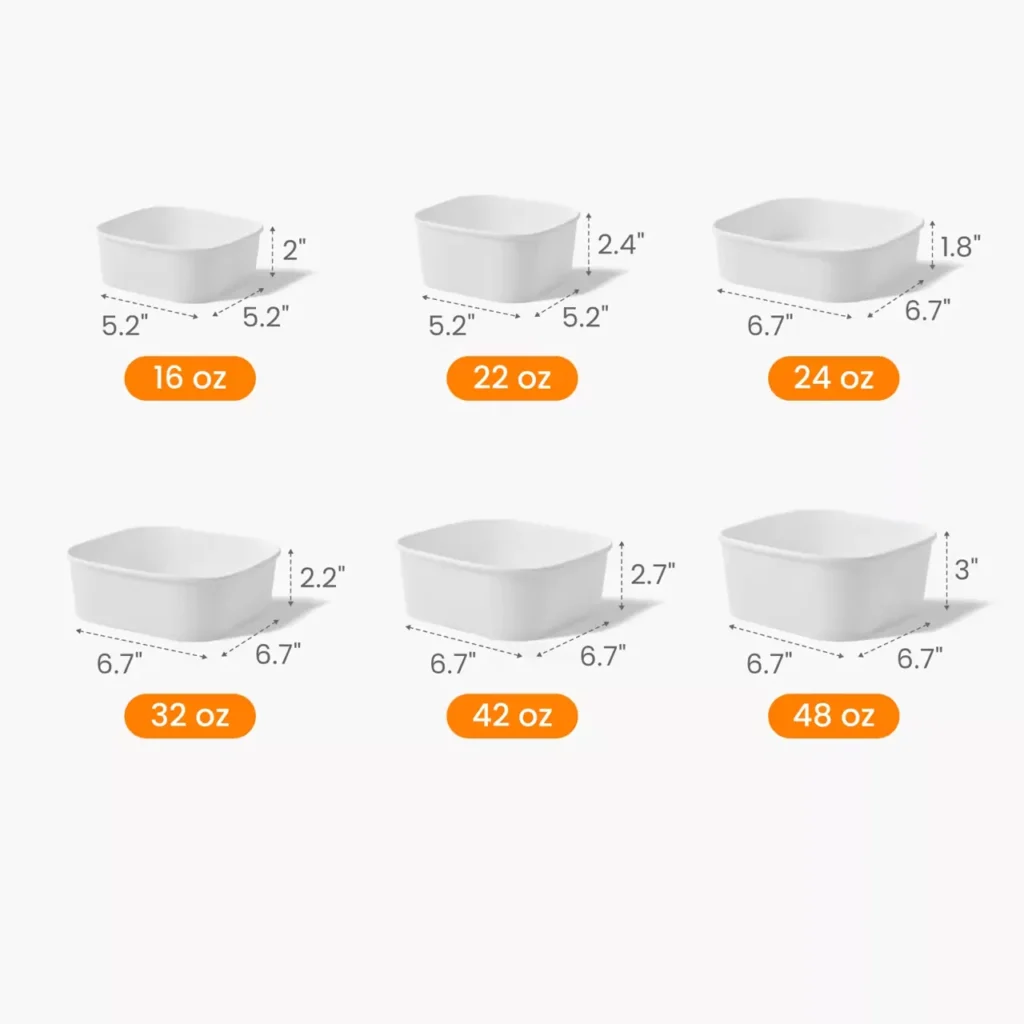
Map your heaviest-selling menu item first — that’s the size that earns the custom order.
1. Small Portions and Sides
16–22 oz — sides, snack portions, kids’ meals
2. Main Meals and Standard Bowls
24–32 oz — single-serve entrées, grain bowls, pasta. Square containers in this range stack four across in a standard delivery bag without wasted space.
3. Family-Style or Larger Servings
42–48 oz — shared dishes, catering, bulk meal prep kits
4. When Leak-Resistant Lids Matter Most
Leak-resistant lids are non-negotiable when:
- The meal contains broth, sauce, or dressing
- Orders travel more than 15 minutes
- Bags are stacked during multi-stop deliveries
Friction-fit lids fail. Snap-lock lids with a recessed channel hold. The cost difference per unit is cents. The customer service cost of a spill is not.
What Happens After Purchase: Storage, Inspection, and Reorders
1. How to Inspect the First Shipment
The first pallet tells you everything about how consistent your packaging supplier is — and consistency is what your brand depends on. Specifically check:
- Lid fit on 10+ random containers (should close flush, no gaps)
- Print registration and color accuracy against your approved proof
- Base seam integrity — press the center and check for give
2. How to Store Bulk Packaging Safely
Moisture is the enemy. Store flat, dry, away from concrete floors that sweat in humidity. Don’t exceed the supplier’s stacking height — warped bottom boxes cause lid-fit problems on the whole batch. If storage space is a real constraint, Fusenpack’s free warehousing lets you order at volume and pull shipments as needed — handy for brands running a lean kitchen with no back room to spare.
3. What to Keep Consistent for Repeat Orders
Write down your exact spec — board weight, liner type, print file version — and treat it as a contract, not a memory. One Ohio-based meal prep brand got their second order 2mm shorter than the first. Their branded bag inserts no longer fit. That’s a reprint and a delay they didn’t budget for.
Why Customization Can Improve Sales, Not Just Appearance
A printed container isn’t decoration — it’s a sales tool that rides along to the customer’s home. According to a 2023 Dotcom Distribution report, 40% of consumers say they would share a photo of branded packaging on social media, creating organic reach with zero ad spend. [Source: Dotcom Distribution E-Commerce Consumer Study 2023]
Custom paper meal prep containers can carry:
- Your logo and brand colors
- QR codes linking to reorder pages or loyalty programs
- Nutrition info that reinforces health-forward brand positioning
- Seasonal messaging that changes perception without changing the product
A Dallas fitness meal prep brand switched from plain white containers to fully branded square boxes in mid-2023. In just 60 days, its Instagram unboxing posts tripled — the food and recipes didn’t change, just the packaging.
The new boxes gave customers something to post about. The brand printed nutrition info on one side and a subscription QR code on the other — and that QR code got more repeat orders.
Fusenpack’s custom meal prep containers let you print full colors (CMYK and Pantone) on all sides. If you don’t have a designer, their free design service helps you look professional — no big creative budget needed.
FAQ
Q: What’s the MOQ for custom paper meal prep containers?
A: Fusenpack’s custom square meal prep container starts at 5,000 units.
Q: Can I print my logo and brand colors on the container?
A: Yes. CMYK flexographic and Pantone printing are both standard options.
Q: How long does production take?
A: Most custom orders ship in 8-12 weeks.
Q: Which size fits most meal prep menus?
A: 32 oz square is the workhorse — handles single-serve bowls, portioned entrées, and most salads without excess headroom or a tight squeeze.
The box you choose is the final impression your customer gets from you. Make sure it’s perfect.