Custom Take Out Boxes: Sizes, Materials, and Minimum Order Quantities
By
Contents
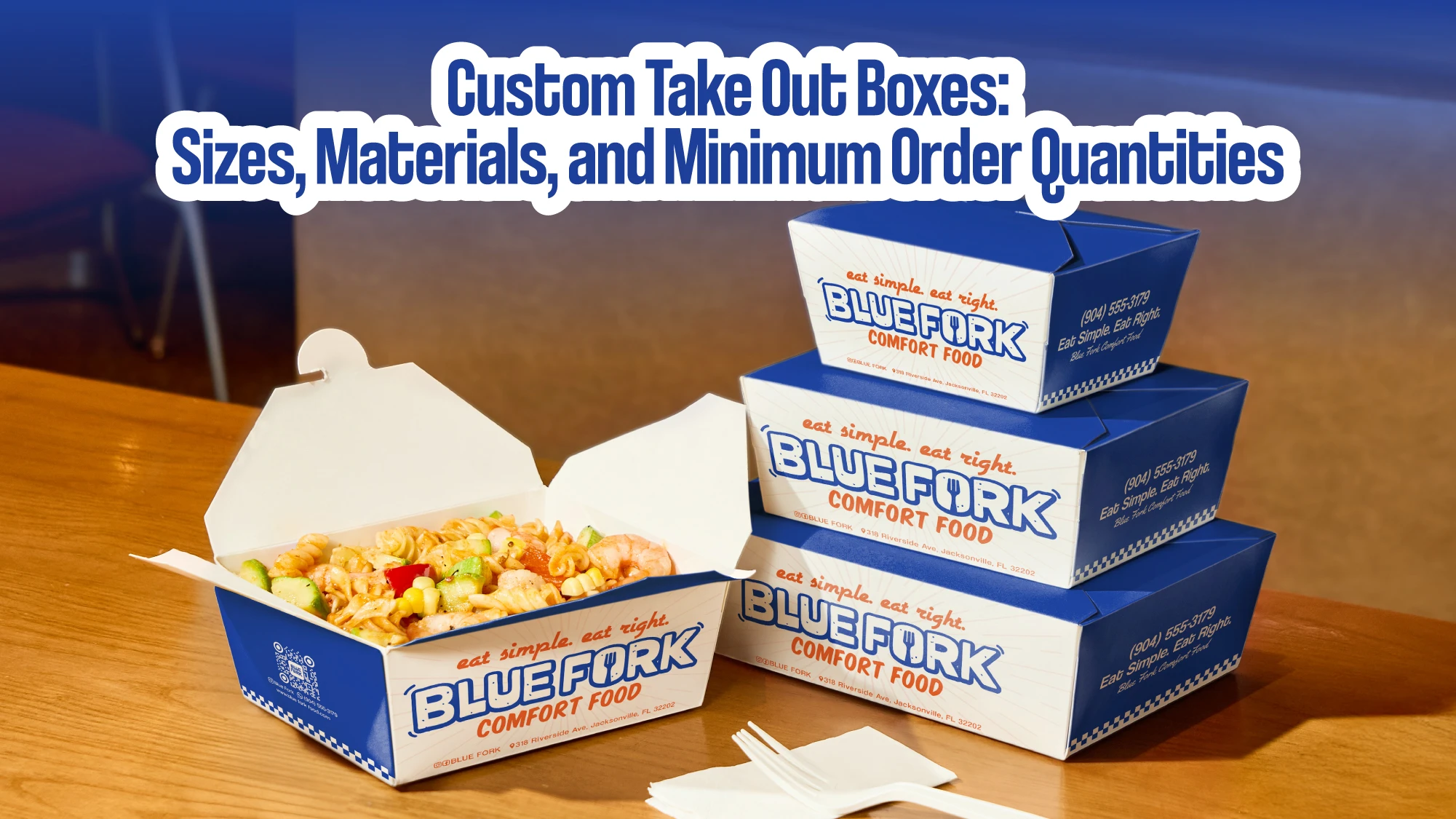
Size is where a takeout box order starts. It is rarely where the difficulty is. Board grade decides whether the box survives a forty-minute delivery, colour count quietly doubles the minimum order, and the reheat question comes up from customers long before it comes up from your supplier. None of these are hard problems on their own. They only become one when a single quote forces you to answer all three at once.
What follows separates them. Standard size tiers first, then how to read a board grade against what you are actually packing, then the specific levers that raise or lower a minimum order. The microwave question gets its own treatment, since buyers ask it more than almost anything else. There is also a note on where boxes stop being the right format, because plenty of menus end up splitting across boxes, bags, and containers once someone lists everything out.
Quick Answer for Buyers Comparing Quotes
Custom take out boxes are typically sized to a handful of standard footprints. Cutting fresh for every order is rare, because a stock die keeps both price and lead time down. Material choice follows from grease and moisture exposure. Plain kraft or SBS paperboard handles dry to lightly greasy food. A poly or wax coating is what stops sauce and oil from soaking through. Minimum order quantity is driven by print setup, not by policy. Digital printing needs no plates, so short runs stay affordable. Flexo or offset printing requires a plate per color, and only pays off at volume. On the microwave question, plain uncoated kraft or corrugated board generally tolerates a brief reheat. Anything with a wax lining, foil, plastic coating, or metal closure should not go in. When a box is unmarked, transfer the food to a microwave-safe plate. Guessing is not worth it.
Custom Take Out Boxes: Four Decisions Side by Side
| Decision | What it depends on | Where buyers go wrong |
|---|---|---|
| Size | Portion volume and whether the box needs to vent steam | Ordering one size for a whole menu instead of two |
| Material | Grease, moisture, and hold time before the food is eaten | Choosing plain kraft for wet or oily items that need a coating |
| MOQ | Print method, color count, and whether a new die is needed | Assuming MOQ is fixed rather than tied to setup cost |
| Microwave use | Coating, lining, and any metal component | Assuming all cardboard behaves the same way in a microwave |
This page covers the box format specifically. For the full range of custom packaging, including takeout bags and to-go containers, start with the custom food packaging buyer’s guide. If you are outfitting an entire new location rather than sourcing one item, the custom restaurant packaging guide sequences the whole order for you.
Choosing the Right Box Type and Size
Before picking a size chart, it helps to confirm that a box is even the right format. Takeout boxes, bags, and wet-food containers solve different problems. A menu built around one format usually needs a second for the items that do not fit.
Custom Takeout Boxes vs. Custom Take Out Bags: Which Format Fits the Order
Boxes hold their shape under stacking, and they protect food that would be crushed in a bag. That makes them the default for entrees, multi-item combos, and anything layered. Bags, by contrast, suit single items and food that travels upright. Our guide to custom takeout bags covers handle types and paper weights in detail. They also suit orders where a handle matters more than rigidity. Buyers comparing bags against boxes for the same menu item are usually asking about grease control and carry distance. Box shape is rarely the real question. A heavier paper bag can outperform a lightweight box on a short walk to a car. Once the order includes sauce, a coated box wins over any bag. The same logic applies to delivery-only concepts. There, a sealed bag closure often matters more than the container inside it.
Custom Take Out Containers for Sauces, Soups, and Wet Sides
Once a menu includes soup, sauce on the side, or anything with standing liquid, a folding box stops being the right container. Coating does not fix it, because the seams are not built to hold liquid under tilt. That is where custom take out containers take over. They are sometimes searched as custom take-out containers or custom takeout containers, and they use a hinged or snap-fit lid. For a full breakdown of container types by food temperature and moisture level, see custom to-go containers, which covers the wet-food side of the range this page does not.
Standard Custom Takeout Box Sizes
Most custom takeout boxes on a restaurant menu cluster into three or four working sizes rather than a continuous range. Cutting a new die for every SKU adds tooling cost without much practical benefit. Four sizes cover the large majority of quick-service and casual-dining menus. A single-entree box. A combo-meal box roughly half again as large. A family or sharing size. And a slim clamshell-style box for sandwiches or wraps. Ordering fewer sizes and using portioning to fill them consistently is usually cheaper than ordering a size for every dish.
| Tier | Typical use | Relative capacity |
|---|---|---|
| Slim | Sandwiches, wraps, flatbreads | Smallest |
| Single-entree | One main dish plus a side | Small-moderate |
| Combo meal | Main plus multiple sides | Moderate-large |
| Family/sharing | Multi-portion or shared orders | Largest |
Material and Print: What Changes the Price
Material and print method are where a takeout box quote gets decided, and the two interact more than buyers expect. A heavier board costs more per unit before a single color is printed on it. A coating or lamination adds a separate line item on top.
Custom Printed Takeout Boxes: Coatings and Print Area
Custom printed takeout boxes fall into two broad categories: paperboard printed directly, and paperboard laminated or coated before printing. Direct printing on uncoated kraft is the cheapest path, and it prints logos cleanly. On its own, though, it offers no grease or moisture barrier. A poly coating or wax lamination adds that barrier and typically also improves print vibrancy, at added cost per unit. Print area is usually limited to the outward-facing panels. The inside of the lid and the base are rarely printed, since that surface contacts food directly.
| Material | Dry food | Light grease | Heavy grease/sauce | Standing liquid |
|---|---|---|---|---|
| Uncoated kraft/SBS | Yes | Yes | No | No |
| Corrugated | Yes | Yes | No | No |
| Poly-coated or wax-laminated board | Yes | Yes | Yes | No |
| Molded fiber (uncoated) | Yes | Yes | No | No |
| Hinged/snap-fit container, coated | Yes | Yes | Yes | Yes |
Can You Microwave Cardboard Takeout Boxes?
This depends entirely on what the box is made of, not on the fact that it is cardboard. Plain, uncoated kraft or corrugated board can generally tolerate a short reheat. It is mostly cellulose, with no metal or plastic to arc or melt. The risk comes from what is added to the board. A wax lining can melt. A full plastic coating or laminate can warp or leach. And any metal component, including staples, foil accents, or wire handles, does not belong in a microwave at all. So can you microwave takeout boxes in general, and does the answer change for a specific kind of order? Can you microwave Chinese takeout boxes, and are longhorn takeout boxes microwave safe, or any other specific chain’s box? Those questions are the same material question in different words. Check for coating, foil, or metal before reheating, regardless of which restaurant the box came from.
Paper raises a narrower version of the same question. Can you microwave paper takeout boxes, and are paper takeout boxes microwavable across the board? Uncoated paper generally behaves like uncoated kraft board, while a plastic-coated or wax paper takeout box does not. When a box carries no microwave-safe marking, transferring the food to a plate is the safer default. For the fuller safety breakdown by coating and lining type, see our guide on whether paper takeout boxes are microwavable.
Minimum Order Quantity and Lead Time
MOQ on a custom take out box is set by tooling and print setup, the same mechanics described in the buyer’s guide to custom food packaging. That is why it moves so much between suppliers, and between print methods. A digital press needs no plates, so short runs of a few hundred units stay economical. Flexographic or offset printing needs a physical plate for every color, which is what pushes the floor up. Consequently, a two-color logo printed digitally on a stock box size carries a much lower minimum. A four-color design cut to a bespoke footprint on an offset press sits far higher.
| Setup | Relative MOQ | Why |
|---|---|---|
| Digital, stock die, 1-2 colors | Lowest | No plates, no new tooling |
| Digital, bespoke die | Low-moderate | Die cost only, no plate cost |
| Flexo/offset, stock die | Moderate-high | Plate cost per color, existing die |
| Flexo/offset, bespoke die, full color | Highest | Plate cost per color plus new die |
Lead Time, Stage by Stage
Lead time follows a predictable order once MOQ and structure are settled. Artwork approval first. Then a physical pre-production sample, the production run, and transit. Artwork is usually the slowest step, because it is the one still in the buyer’s hands. A missed bleed or a logo sitting across a fold sends it back for another round. Load the pre-production sample with real food rather than checking it empty. That catches problems a flat proof cannot, including whether the lid seats correctly and whether grease resistance holds up under a real portion.
Food-contact compliance sits underneath all of this. For paperboard components touching aqueous or fatty foods, the relevant federal rule is 21 CFR 176.170, which sets extractives limits by food type and condition of use. If a molded fiber or compostable option is on the table, ask which standard it was tested against; the common reference point is ASTM D6400, and if it carries BPI certification, that scheme additionally caps total organic fluorine at 100 ppm. Several states now restrict intentionally added PFAS in paper food packaging on a phased schedule. Confirm compliance for every state an order ships into. One certificate rarely covers all of them.
Putting Together a First Order
A first order of custom take out boxes tends to go smoothly when the size count stays small. Choose the material against the greasiest or wettest item on the menu, not the driest. Then start the MOQ conversation from print method rather than from a target unit price. Custom molded fiber takeout containers are worth a look if a compostable claim matters to the brand. They typically need their own coating decision for anything beyond dry food. Custom take-out menus printed to match the boxes are a common add-on on a first packaging order. A menu is still a separate print job, with its own setup and MOQ.
For the format questions this page does not cover in depth, including handle types and paper weight for bags, see custom takeout bags. For venues building out a full packaging list by category, the burger packaging checklist and pizza shop packaging checklist both start from a box or container and work outward. And for the barrier layer that sits underneath most fried or baked items regardless of box choice, see greaseproof paper for food.
Frequently Asked Questions
What’s the difference between custom takeout containers and custom takeout boxes?
Boxes are typically a folded, hinged, or telescoping paperboard structure meant for dry to moderately greasy food. Custom takeout containers usually refer to the wider category. That includes clamshells, cups, and lidded tubs built for wetter or hotter food, often in molded fiber or plastic rather than folding paperboard.
Is custom take out packaging the same thing as a custom takeout box?
No. Custom take out packaging is the umbrella term for the whole category, including boxes, bags, containers, cups, and wraps. A takeout box is one format within that category. You choose it when the food needs structure and stacking protection, not a handle or a liquid-tight seal.
Are customized take out boxes different from stock custom boxes?
Both are custom in the sense of carrying your branding. But a stock size with your logo printed on it costs less. It also ships faster than a box cut to a new footprint. The stock version reuses an existing die and avoids that tooling charge.
What sizes do custom takeaway boxes come in?
Most menus run on three to four working sizes. A single-entree size. A combo size roughly half again as large. A family or sharing size. And a slim size for sandwiches or wraps. Ordering within that range rather than requesting a new size per dish keeps both cost and lead time down.
Can I order custom printed take out boxes in small quantities?
Usually yes, if the job stays digital. Digital printing carries no plate cost. So a stock box size with one or two colors can be ordered in a few hundred units. The minimum climbs once the job moves to flexo or offset printing or adds a bespoke die.
What does 350 GSM kraft paperboard mean for a takeout box?
Some buyers search directly for a custom takeout box 350 gsm kraft paperboard spec. GSM stands for grams per square meter. It measures the weight and thickness of the paperboard, not any single supplier’s product line. A higher GSM generally means a stiffer, more rigid box. It holds its shape better under a heavy or hot portion, at a higher material cost than a lighter board.
Getting the First Box Order Right
Custom take out boxes are a simpler purchase than the first quote makes them look. Treat size, material, MOQ, and microwave suitability as four separate questions instead of one. Settle the material against the worst-case item on the menu, using the material section of the custom food packaging buyer’s guide as the reference. Keep the size count small. And ask what specifically is driving the minimum order before negotiating the unit price. The box that survives the food and the box that photographs well are not always the same choice. It is worth knowing which one you are buying.