Custom Take Out Bags: Handle Types, Paper Weights, and Load Limits
By
Contents
- The Two Specs That Decide the Outcome
- Custom Take Out Bags: Four Decisions Side by Side
- Handle Styles and When Each One Holds Up
- Paper Weight and What It Actually Predicts
- Grease Resistance and Print Area
- Ordering Bags Alongside the Rest of a Menu
- Frequently Asked Questions
- Before You Approve the Bag Sample
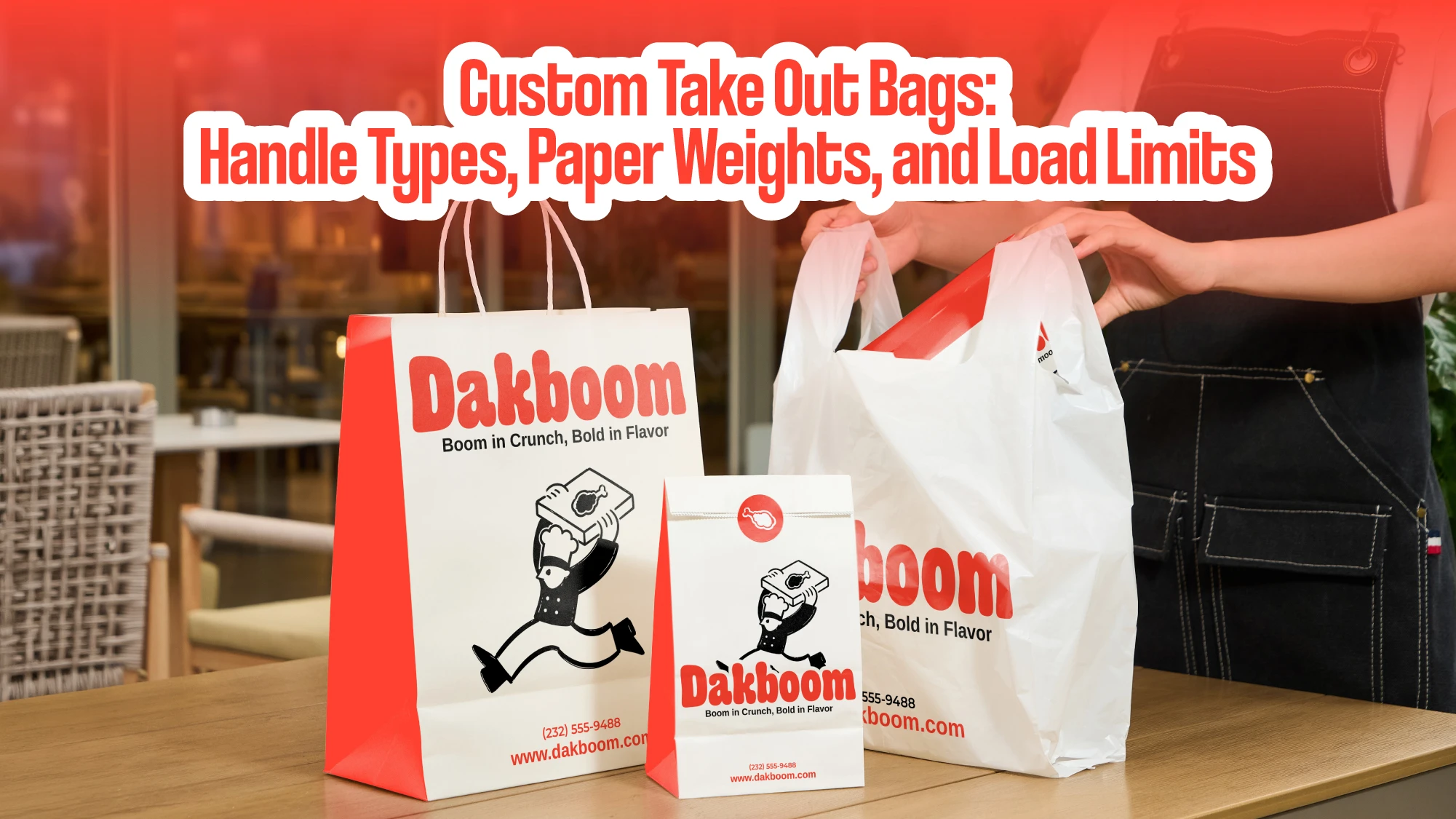
A handle tearing in a parking lot is the failure nobody quotes for. It is also the most common one. Two specifications decide whether it happens: the handle style attached to the bag, and the paper weight carrying the load beneath the printing. Suppliers rarely present those two side by side, which is why bags get chosen on print quality and then get replaced within a quarter.
Handle types come first below, matched to the order profiles each one suits. Paper weight follows, in terms of what it predicts about carrying capacity rather than what the number itself means. After that, when a grease-resistant coating earns its cost, and how print area on a bag differs from print area on a box. The last section covers the point at which a bag stops being the right answer and a rigid format takes over.
The Two Specs That Decide the Outcome
Custom take out bags come in a handful of handle styles. The style should follow the order weight and carry distance, not the other way around. Flat-bottom bags with twisted paper handles suit heavier, multi-item orders carried by hand for a short distance. Die-cut handle bags, integrated into the bag wall, cost less and suit lighter single-item orders. Paper weight, measured in grams per square meter, predicts load capacity better than bag size alone. A larger bag in a light paper can fail before a smaller bag in a heavier one. Grease resistance is a separate decision from weight. A heavy uncoated bag still lets oil through. So anything fried or saucy needs a coating or an internal liner, regardless of paper weight. Print area on a bag is limited by the flat panel space available before a fold. That is usually smaller than the equivalent area on a box of similar volume.
Custom Take Out Bags: Four Decisions Side by Side
| Decision | What it depends on | Where buyers go wrong |
|---|---|---|
| Handle style | Order weight and how far it travels by hand | Choosing a handle for looks rather than load |
| Paper weight | Total order weight, not bag size | Assuming a bigger bag automatically means a stronger bag |
| Grease resistance | Whether the food is fried, sauced, or dry | Treating heavier paper as a substitute for a coating |
| Print area | Flat panel space before the first fold | Designing artwork that assumes box-sized print area |
This page covers the bag format specifically. For the full range of custom packaging, start with the custom food packaging buyer’s guide, which sequences bags against boxes, containers, and cups for a full first order.
Handle Styles and When Each One Holds Up
Handle construction is the first thing that fails on an underspecified bag, usually well before the paper itself gives out. The handle attachment point concentrates all of the load onto a small area. So it deserves more sourcing attention than the bag body.
When a Handle Beats a Structure: Bags vs. Custom Take Out Boxes
A bag makes sense for a small number of items carried upright over a short distance. It also makes sense when a handle matters more than crush protection. Custom take out boxes win once the order stacks or includes multiple entrees. They also win when the order gets set down and picked back up several times before reaching the table. Buyers weighing custom take out boxes against bags for the same order are deciding between carry convenience and structural protection. Price is rarely the real question. A well-made bag and a comparable set of custom kraft takeout boxes often land close on unit cost. A spec sheet quoting a custom takeout box 350 gsm kraft paperboard weight is describing box rigidity. A bag has no equivalent property, whatever its own paper weight. The same comparison shows up in reverse on a bag-led menu. There the buyer is deciding whether a handful of orders need a box instead. Once liquid enters the picture, neither a bag nor a folding box is the right answer. Custom take out containers, built with a sealed or hinged lid, take over. For the box side of the bag-versus-box comparison, see custom takeout boxes.
Custom Takeaway Bags: Twisted Handle vs. Die-Cut Handle
Sandwich and deli orders are the common exception, since those usually travel wrapped rather than boxed; our notes on sandwich packaging cover that format. Twisted paper handles pass through reinforced holes and are knotted or glued inside the bag. That distributes load across a wider area, so they generally carry more weight before failing. Die-cut handles are cut directly into the bag wall near the top. They cost less, since they need no separate handle material or attachment step. But they concentrate stress at the cut edge, so they suit lighter, single-item orders. Custom takeaway bags built for delivery or catering volume typically default to twisted handles. Counter-service bags for a single sandwich or pastry often use die-cut construction to keep unit cost down.
| Order profile | Twisted handle | Die-cut handle |
|---|---|---|
| Single item, short carry | Overbuilt | Good fit |
| Multi-item, short carry | Good fit | Marginal |
| Delivery or catering volume | Good fit | Not recommended |
| Bakery/grab-and-go, light load | Overbuilt | Good fit |
Paper Weight and What It Actually Predicts
Paper weight is expressed in GSM, grams per square meter. It predicts load capacity more directly than bag dimensions do. A large bag in a light paper is not necessarily stronger than a small bag in a heavier one. The failure point is usually the paper’s tensile strength at the handle and the base fold, not the total surface area.
| Tier | Typical load | Coating typically needed |
|---|---|---|
| Light | Single dry item, short carry | No |
| Medium | Multi-item order, dry to light grease | Sometimes, for light grease |
| Heavy | Multi-item order, heavier or bulkier load | Depends on food type |
| Heavy, coated or lined | Greasy, saucy, or moisture-heavy load | Yes |
Custom Take Out Delivery Bag Loads and Carry Wave-Top Bags
A custom take out delivery bag carries a different failure mode than a counter-service bag. It travels farther, gets set down in a vehicle, and is often stacked with other orders. Heavier paper and reinforced handle attachment matter more here than for a walk-up single-item order. Custom take out wave top bags have a folded scalloped top rather than a flat opening. They are typically chosen for bakery or grab-and-go items. There the open top improves visibility and airflow rather than carrying weight. That puts them in the light-to-medium weight tier rather than the heavy one.
A few order types raise their own version of the weight-versus-format question. Custom coffee take out container boxes are the multi-cup carrier trays used for beverage orders. They are usually not paper bags at all. They are a separate molded or die-cut structure sized to hold cups upright. Pairing one with a food bag for the same order is common on breakfast and coffee-shop menus. Delis raise a related question with what is often searched as a custom sandwich wrap take out container – angle cut. That is a fold-and-tuck wrap cut on the diagonal rather than a bag or box. It depends on paper weight for structure the same way a bag does, just without a handle.
Grease Resistance and Print Area
Grease resistance and paper weight solve different problems. Treating a heavier bag as a grease solution is one of the more common sourcing mistakes. A heavy uncoated kraft bag still lets oil soak through; only a coating, wax lamination, or internal liner blocks it.
| Material | Dry food | Light grease | Heavy grease/sauce |
|---|---|---|---|
| Uncoated kraft, any weight | Yes | Limited | No |
| Kraft with wax lamination | Yes | Yes | Yes |
| Kraft with grease-resistant coating | Yes | Yes | Yes |
| Kraft plus internal liner | Yes | Yes | Yes |
Print area on a bag is set by the flat panel space available before the first fold or gusset. For most take out bag formats that is smaller than the print area on a box of comparable volume. Custom printed takeout boxes typically offer more usable flat surface per unit of food volume. That is one reason boxes read as more “branded” on shelf, even at a similar price point. Want a large front-panel logo? Confirm the flat panel dimensions before finalizing artwork. Bag and box print areas do not scale the same way.
Ordering Bags Alongside the Rest of a Menu
Once handle style, paper weight, and grease resistance are settled, the remaining decisions mirror any other custom food packaging order. If the food-contact side of the bag is the part you are unsure about, our guide to food grade paper bags covers which stocks are cleared for direct contact. Minimum order quantity on a bag follows the same tooling logic as any other printed paper product. Digital printing needs no plates. So a small run in one or two colors on a stock bag size stays affordable. Flexo and offset printing require a plate per color. They only pay off once the order climbs into volume territory. A bespoke bag size adds its own tooling cost on top of the print method, exactly as set out in the custom food packaging buyer’s guide. A stock footprint avoids that, the same way a stock die does for a box. Buyers who want low minimums on a first order get there faster by keeping the bag size standard and the color count low. Negotiating unit price directly moves the number far less.
Lead Time on a Bag Order
Lead time follows a fixed order. Artwork approval, then a physical pre-production sample, then the production run, then transit. Load that sample with real food and approve it before the full run ships. Custom carry out bags for a bar or brewery program start from the same handle-and-weight framework. So do custom bakery bags for pastry and bread. Only the finishing details differ. See custom bakery bags for the window-and-grease specifics that bakery orders raise on top of the basics covered here.
Food-contact compliance applies to bags the same way it applies to boxes. The federal rule governing paper components in contact with aqueous and fatty foods is 21 CFR 176.170. If a compostable claim is part of the pitch, ask which standard backs it. The common reference is ASTM D6400, and BPI certification on top of that caps total organic fluorine at 100 ppm.
PFAS Rules That Affect Bag Orders
A growing number of states restrict intentionally added PFAS in paper food packaging on a phased schedule. Confirm the requirement for every state an order ships into.
For sandwich and deli programs specifically, the deli and sandwich packaging checklist sequences bags against wraps and containers for that category. And for the barrier layer that sits underneath most fried or baked items regardless of bag choice, see greaseproof paper for food.
Frequently Asked Questions
What’s the difference between custom takeout containers and custom take out bags?
Containers, whether clamshells, cups, or lidded tubs, hold their shape and can seal against liquid. Bags carry weight through a handle, and they offer no structural protection against crushing or liquid. That is why wet or stacked orders usually move to a container.
Is custom take out packaging always a bag, or does it include boxes too?
Custom take out packaging is the umbrella term for the whole category. Bags, boxes, containers, cups, and wraps all fall under it. A bag is one format, chosen for carry convenience over structural protection.
Are customized take out boxes a better choice than bags for delivery?
It depends on the order. Customized take out boxes protect against crushing during transit and stacking in a delivery bag. That matters for multi-item or hot entree orders. A well-specified heavy-weight bag with the right handle can still perform well for lighter, single-item delivery orders.
Can I get custom printed take out boxes and bags printed to match?
Yes. The print setup is quoted separately for each format, since bag and box print areas differ in shape and available flat panel space. Matching artwork across both is a design decision, not a production constraint.
Do custom molded fiber takeout containers replace a bag?
Not for dry, single-item orders. Custom molded fiber takeout containers are a rigid, often compostable structure. They handle wetter or hotter food than a bag is built to carry. So they usually appear alongside bags in a mixed order rather than instead of them.
What’s the difference between custom take-out containers and custom take-out menus?
These are unrelated categories that sometimes appear in the same order. Custom take-out containers hold food. Custom take-out menus are the printed menu itself. They are ordered as a separate print job, with their own paper stock and setup, often matching the branding on the bags and boxes.
Before You Approve the Bag Sample
Custom take out bags fail more often from an underspecified handle or the wrong paper weight than from a bad print job. Those two decisions deserve more attention than the artwork does. Match the handle to the carry distance and order weight, then check the format against the full packaging range. Size the paper weight to the load, not to the bag dimensions. And treat grease resistance as its own line item, rather than something a heavier paper solves automatically. Get those three right and the rest of the order tends to follow without surprises. When in doubt, order a small test batch in the paper weight and handle style under consideration. Load it with the heaviest, greasiest item on the menu before committing to a full production run. A sample that survives that will handle everything lighter without a second look.