Custom Restaurant Packaging: What to Order First and What Can Wait
By
Contents
- The Sequence in One Paragraph
- Custom Restaurant Packaging: What Lands in Each Stage
- What Belongs in the Opening Order
- Sizing the Budget Without Guessing
- Choosing Suppliers and Comparing Quotes
- Formats to Have on Hand Across Concepts
- Compliance to Check Before You Commit
- Restaurant Packaging Beyond the Opening Order
- Frequently Asked Questions
- Building Your Own Opening List
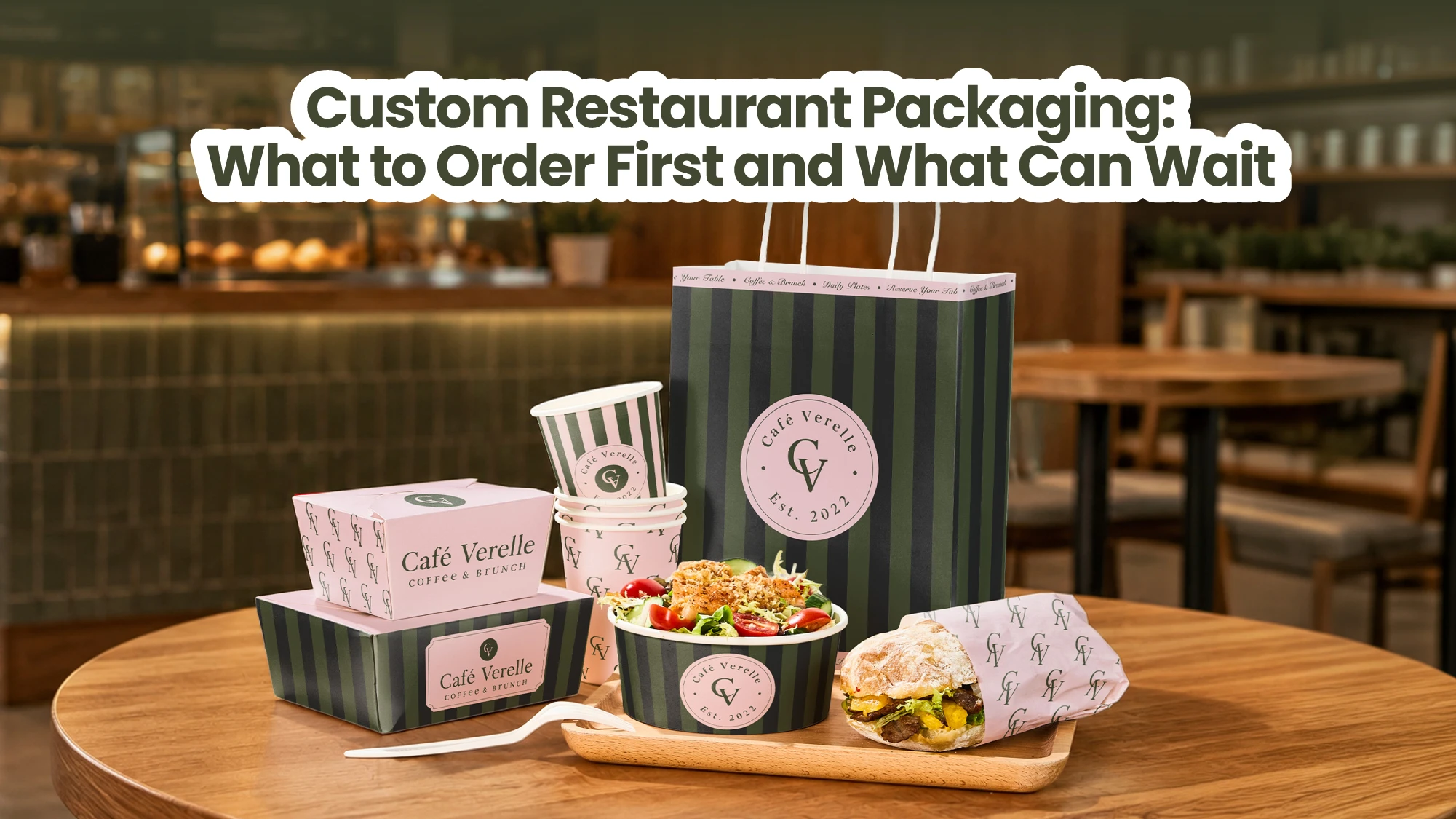
Open a packaging supplier’s catalogue three weeks before service starts and the problem becomes obvious immediately. There are hundreds of line items. Boxes, bags, cups, cutlery, liners, sleeves, and a dozen categories that only make sense once you know your own volume. Almost nobody has the budget or the stockroom to order all of it upfront. As a result, the first purchase usually goes one of two ways. Too thin, and gaps appear by week two. Too broad, and cash sits in cases of printed cups until month three.
Rather than listing every category, what follows puts them in order. What has to exist before the doors open. Next, the items that belong on a thirty-day follow-up once real portion data exists. Finally, whatever can wait for a reorder without causing problems. And how to size that first purchase from covers per day instead of guesswork. Where the concept changes the answer, and a coffee counter really does need a different list than a pizza shop, the format-specific checklist is linked.
The Sequence in One Paragraph
Order the packaging your food cannot leave the kitchen without first, then everything else follows. That usually means one primary container or bag per menu category, plus one cup size if beverages are part of the concept. Order enough of each, meanwhile, to cover two to three weeks without a rush reorder. Printed cutlery, branded liners, and secondary formats such as a second box size for catering trays can wait for a thirty-day follow-up once real sales data shows which items move fastest. Sizing the opening order against covers per day rather than against a supplier’s minimum order quantity keeps cash from sitting in cases you will not touch for a season. Custom restaurant packaging becomes easier to plan once it is treated as a sequence with three stages instead of a single catalogue to clear in one pass.
Custom Restaurant Packaging: What Lands in Each Stage
| Stage | What goes here | Why it sits at this stage |
|---|---|---|
| Before opening day | Primary container or bag per menu category, one core cup size, napkins and utensils in plain or minimally branded form | Service cannot run without these; substituting later mid-shift is the failure mode to avoid |
| First 30 days | A second container size for larger portions, printed cutlery, delivery-specific bags or sleeves | Real order-mix data is now available to size these correctly instead of guessing |
| First reorder and after | Seasonal packaging, catering-specific formats, secondary branding refresh | Demand for these categories is usually too thin in week one to justify tooling and minimum order commitments |
This page is the entry point for sourcing custom restaurant packaging across concept types. For the underlying material and MOQ decisions behind the categories below, the custom food packaging buyer’s guide covers the full range in more depth. If your concept is coffee, burgers, boba, pizza, or sandwiches, jump to the checklist for that vertical. Each one goes category by category for that specific format.
What Belongs in the Opening Order
Custom fast food packaging and full-service dining pull from the same categories, but the priority list is not identical. A counter-service concept built around takeout needs its primary container solved on day one, because there is no plated alternative to fall back on. A full-service restaurant, by contrast, can run its first week on a smaller custom footprint since most food leaves on a plate.
Food packaging for restaurants: the categories that cannot wait
Food packaging for restaurants narrows down fast once you separate what touches every ticket from what touches a fraction of them. Generally, three items account for most packaging volume in a typical opening month. The primary hot or cold container, the bag carrying the bulk of takeout orders, and one cup size if the concept sells beverages. Everything else on the catalogue page, from branded stickers to a second cutlery finish, affects presentation more than it affects whether an order can go out the door.
Custom fast food packaging versus a slower-paced concept
Custom fast food packaging tends to front-load the container and bag decision because turnover is faster and the margin for a mid-shift substitution is thinner. Conversely, a concept with a longer average ticket time can phase in specialty formats later. A takeout box for leftovers or a branded cup sleeve can wait until staff know how often each is requested.
| Stage | What to order |
|---|---|
| Before service starts | Primary container or bag per menu category, one core cup size if beverages are sold, plain or lightly branded napkins and utensils sized to covers per day for two to three weeks. |
| Within the first 30 days | A second container size once portion mix is known, printed cutlery, delivery-specific bags or sleeves once third-party platform volume is measurable. |
| On the first reorder or later | Seasonal or limited-run packaging, catering-specific formats, a branding refresh once the concept’s bestsellers are confirmed. |
Sizing the Budget Without Guessing
Custom food packaging benefits a new restaurant most when the spend matches actual covers rather than a supplier’s suggested case count. The biggest budget risk at opening is over-ordering a printed format before sales data exists to size it. Therefore, buy plain or lightly branded stock for the first few weeks in the hardest categories to predict. Then move to a fully custom, printed version once volume by item is known. The marketing benefits of custom packaging are real and worth capturing. However, they compound over months of repeat exposure rather than in the first week. They should not be the reason an opening order gets oversized.
Custom plastic food packaging and where it still earns its place
Custom plastic food packaging remains the right call for cold, wet, or product-forward items that need a clear window or a tight seal, even on a concept otherwise built around paper and fiber. Notably, supplies in this category are usually a smaller share of the opening order than boxes and bags. That makes them a reasonable place to commit to a fully custom printed run from day one.
| Category | Before opening | Within 30 days | Can wait |
|---|---|---|---|
| Primary box or clamshell | ✓ | — | — |
| Primary takeout bag | ✓ | — | — |
| Core beverage cup | ✓ | — | — |
| Secondary container size | — | ✓ | — |
| Printed cutlery | — | ✓ | — |
| Delivery-specific bag or sleeve | — | ✓ | — |
| Catering-specific format | — | — | ✓ |
| Seasonal or limited-run packaging | — | — | ✓ |
Choosing Suppliers and Comparing Quotes
In practice, the cheapest suppliers are rarely the ones quoting the lowest unit price on a single item. That number usually hides a minimum order quantity forcing a larger opening spend than the concept needs. Instead, a more useful comparison looks at three things. Minimum order across the two or three categories that matter most, sample lead time, and whether tooling is held for a repeat order without a second setup charge.
Custom printed food packaging and what changes the quote
Custom printed food packaging pricing moves mainly on print method and color count rather than on material alone. Digital printing keeps small first orders viable across most categories. Multi-color flexo or offset work usually needs a larger run to make sense. Consequently, holding branded formats until month two beats committing to them at primary-container volume.
Custom sewn bag packaging benefits for delivery-heavy concepts
Custom sewn bag packaging benefits show up most clearly for concepts running heavy third-party delivery volume, where a reinforced seam and insulated liner reduce spillage claims that a standard paper bag cannot fully prevent. That format is worth sourcing early if delivery is more than a small share of opening-week volume, and worth deferring to the thirty-day stage if it is not.
Formats to Have on Hand Across Concepts
Customized food packaging and its regional spelling, customised food packaging, both point to the same sourcing question regardless of market: which core formats appear on almost every opening list no matter the cuisine. Two concepts sit slightly outside that shortlist. A cafe leans harder on the beverage side, which our guide to coffee shop packaging covers, and a morning-trade menu needs formats that survive a commute, covered in breakfast packaging. In practice that shortlist includes a primary container, a takeout bag, a beverage cup if applicable, and basic cutlery, which is also the reasoning behind the format-specific pages linked throughout this guide. For the format-by-format material and sizing detail behind two of the most universal categories, see custom takeout boxes and custom to-go containers.
Custom food service packaging for multi-unit and growing brands
Custom food service packaging decisions get more complex once a concept plans to open a second or third location, because tooling and print plates that were sized for one restaurant’s volume may not scale cleanly. Locking a format early and reusing the same die across locations keeps unit cost down, whereas redesigning packaging between openings usually resets the minimum order calculation each time. The same logic applies to bags. Typically, a style chosen and tooled once for a flagship location travels cleanly to the next site. Switching styles between openings, however, forces a second setup charge.
| Category | Reorder frequency | Tooling investment justified? |
|---|---|---|
| Core containers and bags | Fastest, often weekly to fortnightly | Yes, first priority |
| Cups and lids | Monthly cycle | Yes, once one core size is proven |
| Cutlery, napkins, and liners | Monthly cycle | Usually not, stock items are cheaper |
| Seasonal and catering formats | Occasional or seasonal | No, wait until volume is proven |
Compliance to Check Before You Commit
Custom food container packaging intended for hot or greasy food falls under the same federal framework regardless of which supplier prints it. Paper and paperboard components in contact with food are covered by 21 CFR 176.170, which sets extractive limits by food type and condition of use. Plastic containers, however, fall under a separate FDA framework. If any format is marketed as compostable, ask which standard it was tested against, since ASTM D6400 is the specification most compostable claims in municipal or industrial facilities are measured against. A growing number of states also restrict intentionally added PFAS in paper and plant-fiber food packaging; Washington’s phased restriction under RCW 70A.222.070 is one example. Notably, it applies to paper and plant-fiber formats rather than to plastic. Confirm the compliance documentation for your own ship-to states before the opening order goes out, not after.
Restaurant Packaging Beyond the Opening Order
Restaurant packaging needs keep shifting after the first month as sales data replaces guesswork, seasonal menu items rotate in, and delivery platforms occasionally change their own packaging requirements. Packaging for restaurants that revisit their list on a quarterly cycle, rather than only when something runs out, tend to catch format mismatches earlier and avoid emergency reorders at rush pricing. Packaging that looked right at opening can stop making sense once a menu changes. A container sized for one portion becomes wrong the moment a new dish uses less or more of it. That is a good trigger to reassess the whole list rather than patching around a single item.
Frequently Asked Questions
How many packaging categories does a new restaurant actually need before opening?
Most concepts genuinely need three: a primary container or bag, one core cup size if beverages are sold, and basic cutlery and napkins sized to covers per day. Everything else can reasonably wait for the first thirty-day follow-up order once real sales data exists.
What are the best takeout packaging suppliers for small restaurants to start with?
Look past the lowest unit price on a single item. Instead, compare minimum order quantity across your two or three highest-volume categories together. Also weigh sample lead time and whether tooling is retained for a repeat order. A supplier that is cheapest on one format is not automatically the cheapest opening order overall.
Are there custom food packaging boxes with logo options that work for a small first order?
Yes, provided the print method matches the order size. Digital printing keeps small runs of logo-printed boxes affordable. Multi-color flexo or offset printing needs a larger volume to justify the plate cost. This is why many operators phase branded boxes in after opening rather than at day one.
What should I look for when comparing best custom packaging suppliers sustainable food service programs use?
Ask for the specific certification and test standard behind any compostable or sustainable claim rather than accepting the word alone. A supplier that names ASTM D6400 or a recognized certification body and can produce the paperwork is a materially different commitment than one using the word informally.
How much restaurant packaging should I keep in stock at any time?
Size stock against two to three weeks of covers for core categories rather than against a supplier’s minimum order quantity alone. Holding more than that in a printed format ties up cash in stock that a menu change could make obsolete before it is used.
What changes when I add a delivery platform after opening?
Delivery-specific bags or sleeves and, for concepts selling beverages, spill-resistant lids usually become worth adding once third-party platform volume is measurable. Those formats are reasonable to hold off on for the opening order and revisit as soon as delivery becomes a meaningful share of tickets.
Building Your Own Opening List
Custom restaurant packaging gets easier once it stops being a single catalogue order and becomes a three-stage sequence. First, what service cannot run without. Second, what a month of real sales data lets you size correctly. Finally, what can wait until demand justifies the tooling. Buyers who sequence it this way open with less cash tied up in cases they will not touch for a season. They also avoid the mid-shift scramble of substituting a container nobody planned for. For concept-specific detail, the format checklists linked above go deeper than a single opening-order guide reasonably can.