Custom Printed Cups: Sizes, Wall Types, and Print Methods Compared
By
Contents
- The Answer in Brief
- Custom Printed Cups: Constructions Compared
- Single-Wall, Double-Wall, and Corrugated: What Each Solves
- Hot Cups vs Cold Cups: Different Problems to Solve
- Print Methods and Color Fidelity
- Where Cups Overlap With Other Formats
- Compliance for Food-Contact Cups
- Frequently Asked Questions
- Locking Down a Cup Spec
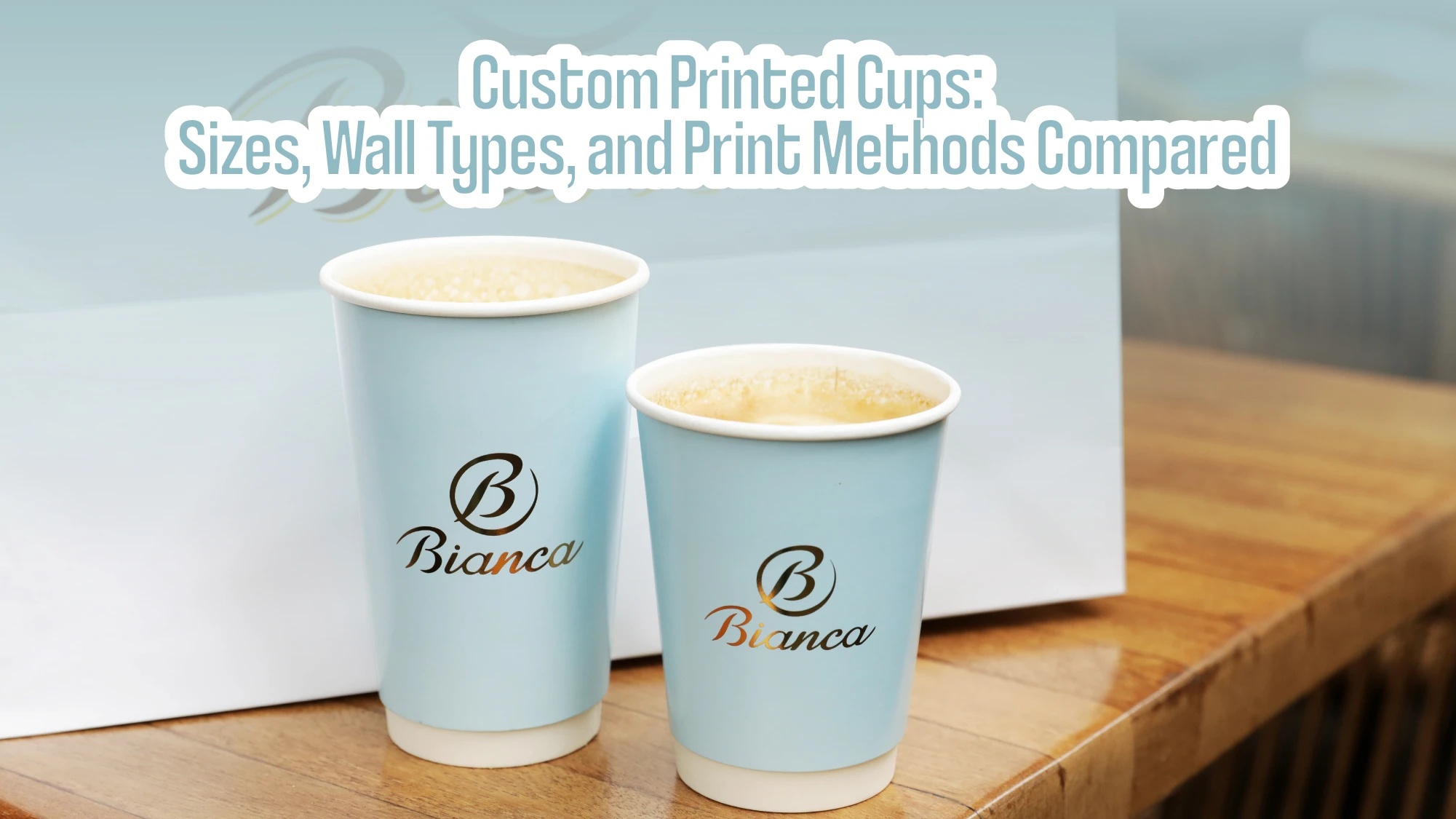
On paper a cup is a single line item with a volume attached. However, comparing two quotes usually reveals otherwise. Wall construction, hot or cold rating, and print method each move price and performance at once, and rarely in the same direction. A cup engineered for iced coffee will burn a hand holding drip coffee. Artwork that looks clean in a four-colour proof can print muddy once it runs on the press the supplier actually uses.
Below, those variables are handled one at a time: wall construction against service temperature, print method against colour fidelity and minimum order, and lid fit against the specific cup body chosen. Because unit cost is where most first orders get decided, each section notes where a spec change moves that number more than switching base material would. Straws, cans, and concept-specific formats such as coffee or boba are linked where they intersect.
The Answer in Brief
Match wall type to temperature first. Hot beverages need double-wall or corrugated construction for insulation and hand comfort, while cold drinks can run on a single-wall cup since condensation, not heat, is the problem to solve there. Subsequently, print method follows from order size and colour count. Typically, digital printing keeps small, multi-colour runs affordable. Flexo and offset need larger volume to justify plate costs, but deliver more consistent colour at scale. Importantly, lid fit depends on rim diameter rather than cup height. Two cups of different sizes can therefore share one lid if the rim matches. Check this before ordering lids as a separate line item. Ultimately, getting wall type and print method right before finalizing artwork prevents the two most common complaints. Namely, a cup that is uncomfortable to hold and print colour that does not match the proof.
Custom Printed Cups: Constructions Compared
| Construction | Best for | Insulation | Typical order volume |
|---|---|---|---|
| Single-wall paper | Cold drinks, iced coffee, soda | Low | Any volume, low unit cost |
| Double-wall paper | Hot coffee, tea | Moderate to high | Mid to large volume |
| Corrugated sleeve style | Hot coffee where a separate sleeve is preferred | High, sleeve is removable | Any volume |
| Plastic, single-wall | Cold drinks, boba, product-forward branding | Low | Any volume |
For the underlying material and MOQ logic behind the full custom range, see the custom food packaging buyer’s guide. If your program is coffee-specific, the coffee shop packaging checklist covers the full cup, lid, sleeve, and carrier list for that concept in one place.
Single-Wall, Double-Wall, and Corrugated: What Each Solves
Custom printed cups split into wall constructions for a reason that has nothing to do with branding and everything to do with heat transfer. A cup that feels fine holding iced coffee will burn a hand within seconds if filled with drip coffee. Wall type is therefore a temperature decision before it is a cost decision.
Custom printed cups and when a corrugated sleeve beats double-wall
Cups built for hot beverages generally choose between a double-wall construction, which builds insulation into the cup itself, or a single-wall cup paired with a separate corrugated sleeve. Generally, sleeves cost less per cup and let a customer remove the layer once a drink cools. Double-wall cups, by contrast, reduce the components a barista handles per order. That matters more at high volume. That trade-off is worth deciding before finalizing custom printed food packaging for a hot beverage program, since switching construction later means re-tooling both the cup and the sleeve.
Custom takeaway cups for cold service
Meanwhile, cups built for cold drinks do not need the insulation a hot cup requires. Instead, the meaningful spec shifts to condensation control and print durability against a wet exterior. Plastic cups hold up well here and also support the clear-window branding that a paper cold cup cannot offer.
| Attribute | Single-wall paper | Double-wall paper | Plastic |
|---|---|---|---|
| Suitable for hot drinks | — | ✓ | — |
| Suitable for cold drinks | ✓ | — | ✓ |
| Visible product / clear window option | — | — | ✓ |
| Lowest unit cost at small volume | ✓ | — | — |
Hot Cups vs Cold Cups: Different Problems to Solve
Naturally, hot coffee cups must survive liquid near boiling without transferring that heat to a hand. This is a physical constraint no amount of print design can work around. Cold cups face a different failure mode entirely: condensation weakening a paper cup’s seams or a wet exterior causing print to smear before a customer finishes the drink.
Where lids fit into the equation
Lid fit is governed by rim diameter, not cup height or wall thickness, so two cups with different capacities can often share a single lid tooling if the rim size matches. In practice, checking this before finalizing a cup order reduces the number of separate lid SKUs to stock. The saving is largest for a concept running multiple cup sizes across a hot and cold menu.
Print Methods and Color Fidelity
Custom printed food packaging in general, and cups specifically, are priced primarily on print method and color count rather than on the base cup material alone. That is the single biggest lever a buyer has over both cost and how closely the finished product matches a design proof.
Digital printing
Little to no plate setup cost, which keeps small multi-color orders affordable. Color consistency can vary slightly between runs, which matters more for a brand with strict color guidelines.
Flexographic printing
Requires physical plates per color, so unit cost drops sharply at volume but the minimum order rises. Color consistency is strong once plates are set.
Offset printing
Best color accuracy and the standard choice for photo-quality or gradient artwork at high volume, but the highest plate cost and longest lead time to set up.
Printed bags, bakery bags, and cup orders all follow the same print-method logic. Therefore, a business ordering across several formats can often standardize on one method rather than re-deciding per category. Additionally, cups ordered alongside printed takeout boxes in the same production run sometimes qualify for combined plate or setup discounts. Ask a supplier about this directly rather than assuming it applies.
| Print method | Minimum order | Colour control |
|---|---|---|
| Digital printing | Lowest, short runs stay viable | More colour variance between runs |
| Flexographic printing | Moderate, plates per colour set a floor | Good, consistent within a run |
| Offset printing | Highest, full plate setup per colour | Tightest colour control |
Where Cups Overlap With Other Formats
Custom cups is a broad enough category that a few adjacent formats regularly come up in the same sourcing conversation. For example, Fusenpack’s range extends to printed bowls for cold desserts and salads, which share a similar print process with cups. It also covers greaseproof and deli paper for concepts needing food-contact liners rather than drinkware. Of course, none of these substitute for a cup. Still, ordering them through one supplier with a consistent print method simplifies a multi-category program.
Bundling cups with other printed formats
For a cafe deciding the whole beverage-side range rather than just the cup, our guide to coffee shop packaging is the wider view. A beverage program that also sells food benefits from the same logic. Printed food containers and paper straws can usually be set to match the cup’s print method and colour palette without adding a second supplier. Concepts building a full takeout menu around a beverage program sometimes extend this to printed food boxes. Ordering them in the same run as the cups consolidates setup costs across formats rather than treating each category as a separate purchase.
For straw pairing, sizing, and regulatory status by state, see custom paper straws. For a canned-beverage alternative to cups entirely, clear soda cans with lids covers sealing and shelf life for that format. If boba or bubble tea is part of your menu, cup sizing there follows its own logic around fill volume and toppings. Fusenpack’s dedicated guide to custom boba cups covers bubble tea cups and wholesale options in the depth that format deserves. It carries enough specification detail of its own to warrant separate coverage.
Buyers researching custom printed plastic cups will find deeper material and print-process detail in Fusenpack’s dedicated plastic cup guide. Similarly, anyone sourcing logo-printed plastic cups for a small run can follow the step-by-step process in the guide to putting a logo on a plastic cup.
Compliance for Food-Contact Cups
Paper cups and paper-based components fall under the same food-contact framework as other paper packaging, governed by 21 CFR 176.170. That rule sets extractive limits by food type and condition of use. Plastic cups, however, fall under a separate FDA framework. If a cup or lid is marketed as compostable, ask which standard it was tested against; ASTM D6400 is the specification most municipal and industrial compostability claims are measured against. Several states also restrict intentionally added PFAS in paper and plant-fiber food packaging, including Washington’s phased rule under RCW 70A.222.070. Confirm the documentation for your own ship-to states before a production order goes out.
Frequently Asked Questions
What is the real difference between custom cups and custom printed cups?
Custom cups can refer to any customization, including size or material changes, while custom printed cups specifically means artwork or branding applied to the cup surface. Most buyers researching this category mean the printed version, since blank cups in standard sizes are typically available off the shelf.
Do custom takeaway cups need to be double-wall?
Only for hot beverages. Custom takeaway cups for cold drinks perform fine as single-wall paper or plastic, and adding double-wall construction there increases cost without solving a real problem.
How small of an order can I do for custom printed hot coffee cups?
Digital printing keeps small multi-color orders viable for custom printed hot coffee cups and custom paper hot cups alike. Flexographic or offset printing generally needs a larger volume to make sense once plate costs are factored in.
Can I use the same lid across different cup sizes?
Yes, provided the rim diameter matches. Lid compatibility is governed by rim size rather than cup height, so checking rim diameter before ordering can reduce how many separate lid SKUs a multi-size cup program needs to stock.
I had a problem with my old supplier and am looking to switch. Who can help me do custom cups for my boba shop?
Fusenpack sources standard cup sizes and print methods for boba and bubble tea programs alongside its general cup range. Separately, the dedicated boba cup guide covers sizing, sealing film, and material for that format. It also handles switch-over questions such as matching an existing sealing machine.
What changes if I want custom printed food packaging bags and cups from the same supplier?
Ordering printed bags alongside cups through one supplier simplifies print-method decisions and sometimes reduces combined setup cost. However, each format still carries its own minimum order quantity. Consolidating suppliers does not automatically consolidate the volume thresholds.
Locking Down a Cup Spec
Custom printed cups come down to three decisions that compound on each other. First, wall construction matched to temperature. Second, print method matched to order size and colour count. Finally, a lid chosen against rim diameter rather than assumed from cup size. Buyers who settle those three before finalizing artwork tend to avoid the two most common complaints, an uncomfortable hot cup and print color that drifts from the proof. Where your program overlaps with straws, cans, or a specific concept such as coffee or boba, the linked cluster pages above go further than a single cup guide reasonably can.