Custom Food Containers: The 2026 Buyer’s Guide That Suppliers Don’t Want You to Read
By
Contents
- 1. The MOQ Trap — What the Market Actually Looks Like
- 2. Material Science: What Actually Works
- 3. Printing Technology: Why Your Logo Looks Terrible
- 4. The Real Cost of Custom Containers
- 5. Regulatory Compliance: PFAS and Beyond
- 6. How to Vet a Supplier
- 7. The Design Playbook
- 8. Sizing, Delivery Platforms, and Seasonal Changes
- 9. ROI Tracker — Fill In Before You Order
The custom food containers industry is worth $4.2 billion and runs on one recurring premise: that buyers don’t do the math. Surprise plate fees inflate invoices by 40%. “Compostable” containers end up in landfills for years. And “custom” orders arrive looking identical to every competitor’s box. We’re Fusenpack — a direct manufacturer of custom food containers working with independent restaurants, fast-casual chains, and food brands across the US. We wrote this guide because we spend a lot of time answering the same questions from buyers who got burned by a previous supplier. Consider it the briefing we wish someone had given them first.
1. The MOQ Trap — What the Market Actually Looks Like
Most suppliers open negotiations with a quote at 50,000 units. According to the 2026 National Restaurant Association Operations Report, 73% of independent restaurants need fewer than 10,000 containers per year. That gap isn’t a coincidence — it’s the business model.
Here’s what the supplier landscape actually looks like when you lay out the full picture:
| Supplier Type | Typical MOQ | Price / Unit (1,000 qty) | Fees to Watch |
|---|---|---|---|
| Big Box (Uline, Webstaurant) | 10,000–50,000 | $0.45–$0.62 | Plate fees $450–$800 |
| Mid-Tier (PacknWood, Eco-Products) | 5,000–25,000 | $0.38–$0.55 | Setup charges $300–$600 |
| Direct Manufacturers (Fusenpack, etc.) | 5,000–10,000 | $0.29–$0.48 | Often waived with design service |
| Print-on-Demand (Packlane, noissue) | 100–500 | $0.90–$2.80 | No setup fees, but 2–5× unit cost |
Source: 2026 Packaging Procurement Benchmark Study
Consider a food truck running 200 orders per week — 10,400 containers per year. A 50,000-unit MOQ puts them nearly five years ahead of their actual need. The cost of climate-controlled storage ($800–$1,500 annually) quietly erases the bulk discount. Most restaurants in this situation end up rebranding before they finish the inventory.
The practical answer for restaurants in the 5,000–30,000 unit range is to find suppliers at that exact tier and order twice annually. This keeps designs current while avoiding the capital tie-up. It’s the model we’ve built Fusenpack around: a 5,000-unit minimum order, free warehousing of remaining stock, and the ability to adjust your design between runs without restarting a production relationship from scratch. It’s also worth noting that print-on-demand platforms have improved meaningfully since 2023. Services like Packlane and noissue now offer co-op programs that bring unit costs to $0.65–$0.90 at 2,000 units. For restaurants that update branding seasonally or run limited-edition packaging, the flexibility can justify the premium. The right answer depends on your specific order volume and how often your design changes — not on a blanket rule.
The International Sourcing Reality
Most mid-tier direct manufacturers, including Fusenpack, produce in China. This creates real operational risks that don’t appear in supplier brochures. Standard production takes 15–25 business days, and ocean freight adds another 25–40 days. That’s a 6–10 week cycle before anything arrives. A miscalculation on inventory means a stockout while you wait. When a defective batch arrives from overseas, resolution typically takes 4–12 weeks. As of 2026, US tariffs on Chinese-manufactured paper and food packaging range from 7.5%–25% — a figure that needs to be factored into any unit cost comparison.
The practical response: place your first order 10 weeks before you need it, keep three to four weeks of generic containers as emergency backup, and qualify a domestic supplier before an emergency forces your hand.
2. Material Science: What Actually Works
“Eco-friendly,” “compostable,” “plant-based” — these words are marketing until you look at the infrastructure behind them. The 2026 EPA Municipal Waste Infrastructure Report found that 76% of certified compostable containers require industrial composting facilities that don’t exist in 68% of US counties. Your customer throws that $0.60 container in the trash. It goes to a landfill. It sits there for years.
| Material | Heat Resistance | Oil / Grease Barrier | Breakdown Time (Landfill) | Cost / Unit (10K qty) | FDA Cert |
|---|---|---|---|---|---|
| Virgin PLA | -10°F to 185°F | 2/5 — Poor | 3–5 years | $0.42–$0.58 | Yes (21 CFR 177) |
| Bagasse (Sugarcane Fiber) | -20°F to 250°F | 5/5 — Excellent | 60–90 days* | $0.38–$0.52 | Yes (FDA / NSF) |
| Molded Fiber (Recycled) | 0°F to 212°F | 3/5 — Moderate | 90–120 days* | $0.29–$0.45 | Depends on coating |
| PE-Coated Paperboard | -10°F to 200°F | 4/5 — Good | Not biodegradable | $0.24–$0.38 | Yes |
| Kraft Paper (uncoated) | -5°F to 175°F | 1/5 — Poor | 2–4 weeks* | $0.18–$0.32 | Yes |
| PET Plastic | -40°F to 140°F | 5/5 — Excellent | 450+ years | $0.15–$0.28 | Yes |
*Requires industrial composting at 140°F+. Source: 2026 Sustainable Packaging Coalition Material Performance Study
Why Bagasse Leads for Hot Food, While PLA Still Has a Place
For hot food, bagasse (sugarcane fiber) is the most honest material choice available. It handles 250°F heat, resists oil without needing chemical coatings, and breaks down in 60–90 days even outside ideal conditions. It’s often priced comparably to PLA and outperforms it in every thermal category that matters for takeout. Fusenpack’s bagasse clamshells and bowls are PFAS-free certified and have been independently tested for structural integrity across 45-minute delivery windows in humid climates — which is where most hot-food containers fail.
That said, bagasse has tradeoffs that deserve acknowledgment. Producing one ton of bagasse fiber requires roughly 200,000 liters of water. Most of the world’s supply is grown in Brazil, India, or Southeast Asia — processed in China — then shipped to the US. If sustainability is a genuine brand value rather than a marketing claim, ask your supplier for a full life-cycle assessment, not just a certification sticker.
The conventional dismissal of PLA is also more nuanced than it first appears. PLA blends (PLA combined with PBAT or TPS) degrade significantly faster than virgin PLA, and urban composting infrastructure has grown 34% since 2022. Twenty-three major metro areas now accept certified compostable packaging at the curb. If you’re operating in San Francisco, Seattle, Portland, or New York, PLA has a real end-of-life pathway. The honest distinction: bagasse is the better choice for hot food everywhere, while PLA is a reasonable option for cold food applications in cities with active composting programs.
The material decision affects everything that follows — cost, performance, regulatory exposure, and the story you tell customers. That’s why restaurants serious about personalised food containers treat material selection as the first design decision, not an afterthought.
3. Printing Technology: Why Your Logo Looks Terrible
Sixty percent of first-time custom container orders are visual disappointments. The problem almost never lies with the supplier — it’s a mismatch between design complexity and printing method that nobody explains at the time of order.
| Technology | Best For | Order Quantity | Setup Cost | Color Accuracy | Detail Level |
|---|---|---|---|---|---|
| Flexographic | Simple logos, 1–3 colors | 5,000–100,000+ | $450–$800 | 85–90% Pantone | 150 LPI — moderate |
| Offset Lithography | Complex designs, photos | 10,000–500,000+ | $800–$1,500 | 95–98% Pantone | 300 LPI — excellent |
| Digital (UV / Toner) | Full-color, short runs | 100–10,000 | $150–$350 | 92–95% CMYK | 600 DPI — excellent |
| Screen Printing | Bold graphics, 1–2 colors | 1,000–25,000 | $200–$400 | 98–100% Pantone | 85 LPI — low |
LPI = Lines Per Inch | DPI = Dots Per Inch | Source: 2026 Print Buyers Association Technical Specifications Guide
The rule of thumb is straightforward: if your logo uses three or fewer flat colors with no fine detail, flexo is sufficient and cost-effective. If your logo includes gradients, intricate linework, or more than three colors, pay for offset or digital. The difference on a 10,000-unit order is roughly $300–$500 — about $0.04 per container. The alternative is 10,000 containers where your brand looks like it was produced in a hurry.
It’s also worth knowing that UV digital printing has closed the gap on offset for orders under 8,000 units. For complex logos at shorter run lengths, digital now delivers comparable results at lower setup cost. The one tradeoff: digital ink sits on the substrate surface rather than soaking in, which matters more for containers that are frequently handled, cold, or wet. For standard hot-food containers with shorter life cycles, digital is a fully legitimate alternative in the 2,000–8,000 unit range.
File Requirements That Kill Projects
Most container project failures happen at file submission, not at printing. A designer sends a JPG. The printer needs a vector EPS with spot colors. Three weeks of back-and-forth follow, and the launch date slips. The critical requirements before submitting any order:
- File format: vector (AI, EPS, or PDF with embedded fonts)
- Color mode: Pantone PMS for flexo and offset; CMYK for digital
- Resolution: minimum 300 DPI for any raster elements
- Bleed: 0.125″ (3mm) beyond the trim line
- Safe zone: critical text at least 0.25″ (6mm) from edges
Reputable suppliers offer free design services that handle all file conversion and will turn a rough concept into print-ready files within 36–48 hours. This eliminates the format problem entirely and saves $300–$800 in freelance design fees. At Fusenpack, our design team handles vector conversion, color proofing, and physical sample production before any production run begins — the majority of first-time orders we receive arrive as a JPG and a sentence of brand direction, which is enough to work with.
4. The Real Cost of Custom Containers
The most persistent myth in this industry: custom containers are expensive. Poorly planned custom containers are expensive. Well-executed ones pay for themselves — but the math depends heavily on who your customers are and how they order.
The Core Calculation
Take a 200-seat restaurant with 60% takeout revenue and 800 weekly orders (40,000 containers per year):
| Cost Category | Generic White Boxes | Custom Printed Boxes | Difference |
|---|---|---|---|
| Container cost (40,000/year) | $0.22/unit = $8,800 | $0.38/unit = $15,200 | +$6,400 |
| Setup / design (one-time) | $0 | $450 (flexo plates) | +$450 |
| Social / paid marketing budget | $1,200/mo = $14,400/yr | $600/mo = $7,200/yr | −$7,200 |
| Customer acquisition cost | $28/customer | $18/customer | −$10/customer |
| Repeat customer rate | 34% | 47% | +13% |
| Annual revenue from repeat customers | $142,800 | $197,100 | +$54,300 |
| Net Year-1 ROI | Custom costs $6,850 more upfront, generates $54,300 more in repeat revenue | ~694% ROI | |
Source: 2026 Toast Restaurant Success Report — Branded Packaging Impact Study
That 694% figure is real — for this specific scenario. It requires a customer base that’s active on social media and delivery platforms, sufficient order volume, and a competitive market where visual branding creates meaningful differentiation. It does not apply equally to a rural diner with a predominantly older clientele, a B2B caterer serving office breakrooms, or a lunch counter with 90% dine-in volume. The Toast dataset oversamples urban, delivery-heavy restaurants — precisely the category where branded packaging performs best. For a café doing 150 orders per week in a smaller market, a realistic Year-1 ROI is 80–120%. Still positive. Very different from the headline number. Use the tracker at the end of this guide to model your own scenario.
The Social Multiplier Effect
800 weekly orders at a 68% photography rate produces roughly 544 food photos per week. Each photo reaches an average of 340 followers, generating approximately 184,960 brand impressions weekly at an effective cost of $0.0008 per impression — compared to $0.15–$0.40 for a paid Facebook ad. The container becomes a self-funded advertising channel.
The caveat worth naming: 68% comes from a study focused on 18–34-year-old urban diners. A broader Pew/Morning Consult study from 2025 puts the all-demographic rate closer to 31%. If your customer base skews older or suburban, model at 25–35% before building a business case around this number.
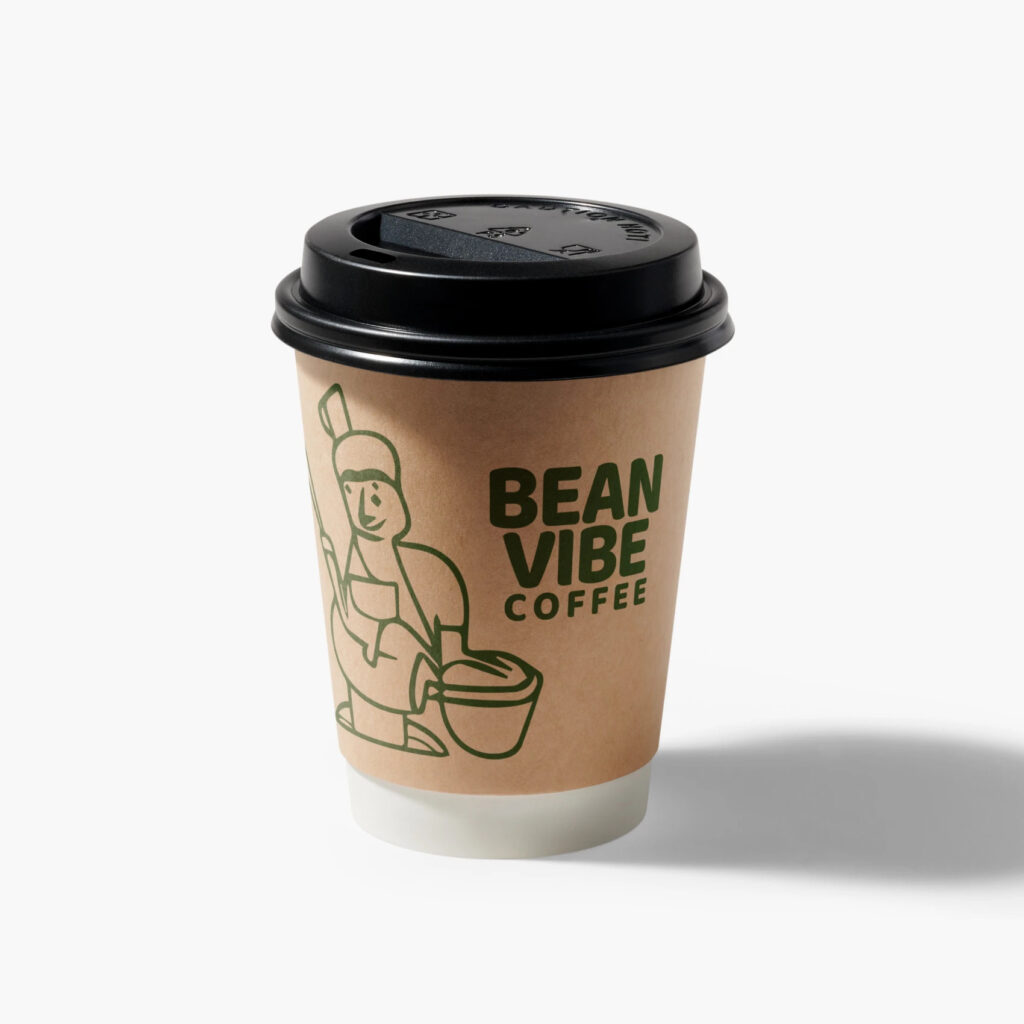
A BBQ restaurant in Austin switched from generic kraft boxes to custom to go containers carrying their logo and a short tagline. Over six months: Google brand searches increased 340%, Instagram tags grew 520%, and catering inquiries rose 280% as corporate clients began seeing the boxes at office lunches. The estimated additional revenue from catering alone was $87,000. The container wasn’t the strategy — it was the evidence of one.
For any restaurant investing in custom take out food containers, the shift in how to think about the purchase is the same: it’s not a packaging cost, it’s an impression cost. And it’s extraordinarily cheap per impression when the design is right.
5. Regulatory Compliance: PFAS and Beyond
PFAS — per- and polyfluoroalkyl substances — are used in grease-resistant coatings and linked to cancer, hormone disruption, and immune system damage. The regulatory wave is moving faster than most restaurant owners realize:
| Year | Action |
|---|---|
| 2024 | California bans PFAS in food packaging (AB 1200) |
| 2025 | Maine, New York, Washington, Minnesota follow suit |
| 2026 | Federal bill HR 2827 pending; likely enforcement by 2027 |
| 2027–2030 | Estimated 40+ states will enact PFAS bans in food service ware |
Source: 2026 Safer States Policy Tracker
The practical risk: order grease-resistant containers today without confirming PFAS-free status and you may be sitting on non-compliant inventory when your state ban takes effect. The only acceptable documentation from a supplier is a third-party lab report showing under 10 ppm total organic fluorine. “Plant-based coating” and “natural formula” are not sufficient answers. Bagasse containers generally don’t require PFAS coatings at all because sugarcane fiber is naturally grease-resistant — one more practical advantage of the material for hot food.
PFAS gets the most attention, but there are three other chemical risks worth asking about. Recycled paperboard can contain mineral oil residues (MOSH/MOAH) from printing inks that migrate into food — request virgin fiber or migration testing documentation for any recycled-content container. Some manufacturers use optical brightening agents to produce whiter containers; these aren’t FDA-approved for food contact in all configurations, so for containers with food contact on interior surfaces, request an OBA-free certification. And BPA restrictions are expanding beyond baby products in several states — confirm BPA/BPS-free status for any polycarbonate containers.
Certification Reference
| Certification | What It Means | Who Needs It |
|---|---|---|
| FDA 21 CFR | Material approved for direct food contact | Everyone — mandatory |
| NSF / ANSI 51 | Public health and safety standard | School / hospital foodservice |
| BRC (British Retail Consortium) | Global food safety standard | Export / large retail chains |
| FSC (Forest Stewardship Council) | Sustainable forestry practices | Eco-focused brands (optional) |
| OK Compost (TÜV Austria) | Industrially compostable — verified | Required to legally make “compostable” claims |
| PFAS-Free (3rd-party lab) | Under 10 ppm total organic fluorine | Any grease-resistant container |
6. How to Vet a Supplier
Price comparison across suppliers is the last thing you should do, not the first. The more expensive supplier who replaces a defective batch in 30 days is cheaper than the bargain option who takes four months to resolve a dispute.
| Question to Ask | Red Flag | Green Flag |
|---|---|---|
| What are your MOQ tiers and per-unit pricing? | “Contact us for a custom quote” | Published tiers: 5K, 10K, 25K with unit costs listed |
| What certifications do you hold? | “We meet all industry standards” | Provides FDA / NSF / BRC certificate numbers on request |
| Can I get physical samples before ordering? | “Samples cost $50+” | Free samples or nominal shipping charge only |
| Do you offer design services? | “We print the file you send” | Free service with 24–48 hour turnaround |
| What is your defect rate and replacement policy? | Deflects, or claims >5% | Under 2% defect rate; free replacement within 30–45 days |
| Can you show physical samples of past work? | Stock photos only, no physical portfolio | Physical samples or verified client case studies available |
How to Handle Defective Orders and Get Fast Replacement Support
When an order arrives defective, the playbook is consistent: photograph every defect type on the day of arrival, count defective units exactly, and notify the supplier within 48 hours. Most contracts require defect notification within 24–72 hours of delivery — miss that window and you may forfeit the claim. Good suppliers offer full replacement or cash refund for defect rates above 2%. Be cautious of “credit toward next order” — that’s structurally inferior to immediate resolution. For any mission-critical container, keep two to three weeks of generic backup inventory because international defect resolution takes four to eight weeks at minimum.
What that looks like in practice: Fusenpack works specifically with restaurants and food brands in the 5,000–50,000 unit range — the segment that big-box suppliers under-serve and boutique printers can’t price competitively. Our clients get a 5,000-unit MOQ, free design service with physical samples before commitment, free warehousing of split orders, FDA and NSF certified materials with PFAS-free documentation on request, and a defect replacement policy with under-2% tolerance. For restaurants placing their first custom order, we also offer a free consultation to match container type, material, and print method to your actual menu — because the wrong container for your food type is a worse outcome than a generic one. If you want to see where we fit in your specific situation, you can start with a quote at fusenpack.com.
7. The Design Playbook
A container that works as a marketing asset does five things at once. Miss any one of them and you’ve paid for packaging, not brand presence.
Primary logo: Minimum 3–4 inches wide, centered at the top — the position that’s visible when containers are stacked. It needs to be legible at six feet. If it isn’t, nothing else on the container matters.
Tagline: No more than six words, placed directly below or beside the logo. “Farm to Table Since 2019.” “Vegan Comfort Food.” “Family Recipes, Real Ingredients.” The tagline carries the meaning the logo can only imply.
Social handle: Instagram preferred — 68% of food photography customers use Instagram versus 41% for Facebook. Format as @YourBrandName with the platform icon, on the bottom edge or a side panel. This is the single element with the most measurable downstream return.
QR code: Optional but high-value when it links to something useful — a digital menu, loyalty program signup, or Google review page. Minimum 1×1 inch for reliable scanning. Side panel or bottom placement. Don’t link it to your homepage.
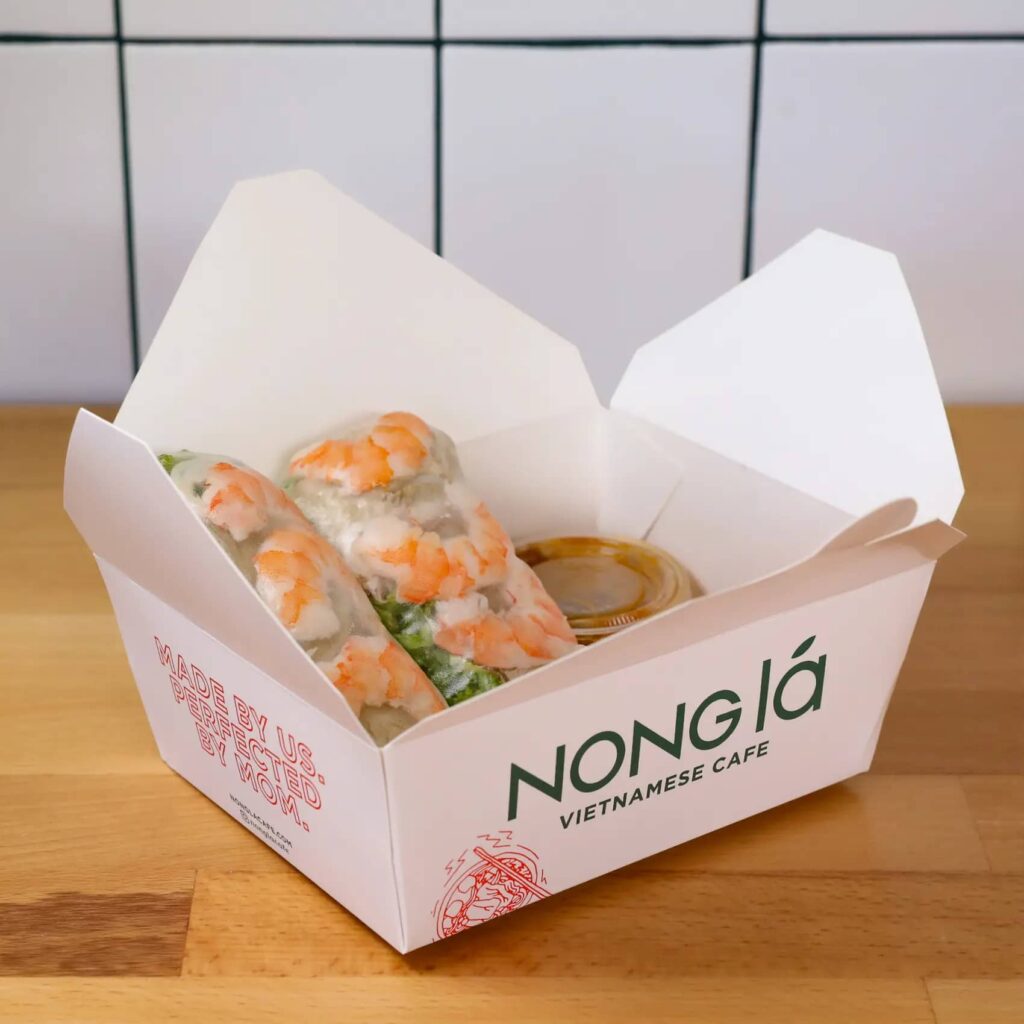
Background pattern: The most overlooked element. A repeating texture or pattern tied to your brand identity prevents the “sticker on a box” appearance that undercuts even a strong logo.
Restaurants investing in personalized take out containers with all five elements consistently see higher organic social sharing than those using logo-only designs. The difference is whether the container gives customers something worth photographing and sharing — or just something to carry food in.
Color and Brand Alignment
| Color | Association | Works Well For | Avoid For |
|---|---|---|---|
| Black / Dark Gray | Premium, sophisticated | Upscale dining, sushi, fine casual | Fast food, family-focused restaurants |
| Kraft / Natural Brown | Eco-friendly, artisanal | Farm-to-table, bakeries, organic | Modern, tech-adjacent brands |
| Red | Appetite, energy | BBQ, pizza, fast-casual | Health food, wellness-focused menus |
| Green | Healthy, natural, fresh | Salad bars, vegan, juice shops | Meat-forward restaurants |
| Navy Blue | Trustworthy, refined | Seafood, Mediterranean, catering | Mexican, Caribbean cuisines |
| White | Clean, minimal | Poke bowls, contemporary concepts | Any brand without strong logo work to anchor it |
8. Sizing, Delivery Platforms, and Seasonal Changes
Match the Container to the Food
| Food Type | Recommended Container | Volume | Non-Negotiable Feature |
|---|---|---|---|
| Ramen / noodle bowls | Bagasse round bowl + vented lid | 32–48 oz | Steam vents — prevents soggy noodles |
| Fried chicken | Tuck-top paperboard box | Custom to order size | Ventilation holes + grease liner |
| Salads / grain bowls | Clear PET or PLA dome lid bowl | 24–32 oz | Transparent lid for visual presentation |
| Burgers / sandwiches | Clamshell or tuck-top box | 5×5 to 7×7 inch | Separate sauce compartment |
| Pizza | Corrugated B-flute box | 10″ / 12″ / 14″ | Vent holes + moisture-absorbing pad |
| Soup / broth | PE-coated container + snap lid | 16–32 oz | Double-wall insulation; leak-proof seal |
| Desserts / pastries | Clear PET dome container | 8–16 oz | Anti-fog coating; secure closure |
| Family meal kits | Aluminum tray + cardboard lid | Full tray (13×9) | Oven-safe; stackable for delivery |
Delivery Platform Requirements
DoorDash, UberEats, Grubhub, and Instacart all have packaging guidelines that affect your platform rating, and most restaurant operators don’t know they exist. As of 2026, most major platforms require tamper-evident seals on all order bags — budget $0.03–$0.06 per order for seal stickers if your containers don’t have integrated locks. UberEats’ partner guidelines recommend insulated or double-wall containers for any order with a transit time over 20 minutes. Containers that collapse under the weight of adjacent orders generate customer complaints that directly damage your platform rating. Keep individual container weight below 85g where your menu allows — consistently heavy packaging can flag your account for delivery inefficiency reviews.
Handling Menu Changes Within Your MOQ
You commit to 10,000 units in March. By June, you’ve added a new dish that needs a different container size. Four strategies handle this without wasting inventory. First, build flexibility into the design from the start — put branding on a paper sleeve or band rather than directly on the container, so the sleeve changes cheaply while the base container remains generic. Second, ask suppliers to split a MOQ across two sizes; most mid-tier manufacturers will divide a 10,000-unit order into two 5,000-unit runs at no extra charge. Third, use a branded bag for variable items and save the custom containers for your hero products. Fourth, negotiate design rollover terms — some suppliers allow one design change per year at no additional plate fee if the base design stays consistent.
The brands that get the most value out of personalized to go containers treat them as a living brand asset with built-in flexibility, not a static bulk purchase. Build those terms into your supplier relationship from the first conversation.
Financing the Upfront Investment
Custom packaging requires upfront capital that strains thin margins. Net-30 payment terms are available from most established suppliers — ask directly, as they’re rarely advertised. The SBA 7(a) Microloan program covers working capital including inventory purchases up to $50,000 at competitive rates. Some lenders classify bulk packaging as “equipment” eligible for 5–7 year financing terms. If you operate in a shared kitchen or incubator, ask about group purchasing contracts — this is often the single fastest route to mid-tier pricing for small operators.
9. ROI Tracker — Fill In Before You Order
Record your baseline numbers before placing the first order. Update monthly for six months. If you aren’t seeing at least 5–10% movement by Month 3 in the metrics most relevant to your restaurant type, the issue is usually design execution or supplier quality — not the strategy itself.
| Metric | Baseline | Month 1 | Month 3 | Month 6 | Target |
|---|---|---|---|---|---|
| Takeout orders / week | _____ | _____ | _____ | _____ | +10% |
| Instagram mentions / month | _____ | _____ | _____ | _____ | +200% |
| Google “[Brand]” searches | _____ | _____ | _____ | _____ | +150% |
| Repeat customer rate | ___% | ___% | ___% | ___% | +8–12% |
| Customer acquisition cost | $____ | $____ | $____ | $____ | −20% |
| Average order value (takeout) | $____ | $____ | $____ | $____ | +5% |
| Defect / complaint rate | ___% | ___% | ___% | ___% | <2% |
Custom food containers create real, measurable results when the customer demographics fit, the design is executed cleanly, and the supplier relationship is built on realistic lead times and documented quality standards. They are not a universal revenue machine. A well-branded container around a great meal, delivered on time — that’s the combination. The container alone is only ever one part of it.
Before placing your first order: request physical samples, confirm PFAS-free status with lab documentation, and allow 8-12 weeks of lead time if you’re sourcing internationally. If you’d like to see what Fusenpack can do for your restaurant specifically — including a free design consultation and no-obligation sample — visit fusenpack.com. That’s the full checklist for doing this right.
Related Reading
- How Custom Take-Out Food Containers Attract Customers
- Custom To-Go Containers: Drive Restaurant Branding and Sales
- Personalised Food Containers: Make Your Restaurant Stand Out
- Personalized Take-Out Containers: The Future of Food Delivery
- Why Personalized To-Go Containers Are a Must for Food Brands