How to Choose the Right Insulated Tote Bag for Food Delivery
By
Contents
Food leaves the kitchen at 160°F and arrives at 120°F. The kitchen did nothing wrong. The bag did. Choosing an insulated tote bag for food delivery is the step most operators rush, and it is the one that decides whether the last twenty minutes of a route undo everything the kitchen got right.
Because a cheap bag looks identical to a good one in a product photo, the difference only shows up once the cheese has set and the customer is typing a review. So the decision comes down to matching three things: your average route time, your most common container, and your daily order count.
The Short Answer
Start with your average delivery time, because it sets the minimum foam thickness. Under fifteen minutes, a 3 to 5mm liner does the job. Fifteen to thirty minutes needs 5mm plus a reflective inner lining. Past thirty minutes, however, you want 10mm or more.
The target the bag has to hit is fixed. USDA Food Safety and Inspection Service puts the bacterial “Danger Zone” between 40°F and 140°F, where bacteria can double in as little as 20 minutes. Everything below is therefore about staying outside that band for the length of your route.
Then size the bag around your largest container with one to two centimetres of clearance per side, rather than around a category name like “large.” Finally, check four things on a physical sample before ordering in bulk: stated foam thickness in millimetres, zipper action, whether the lining beads water, and whether the handles are sewn into the main seam instead of clipped on.
Custom printing becomes worth the premium at roughly fifty deliveries a day, average order value above $15, and a planned service life of at least six months.
Choosing an Insulated Tote Bag for Food Delivery: Start With Route Time
Before comparing any two products, work out your typical route length. Not your fastest run, and not the outlier that took forty minutes in traffic. The median is what your bag has to handle every shift.
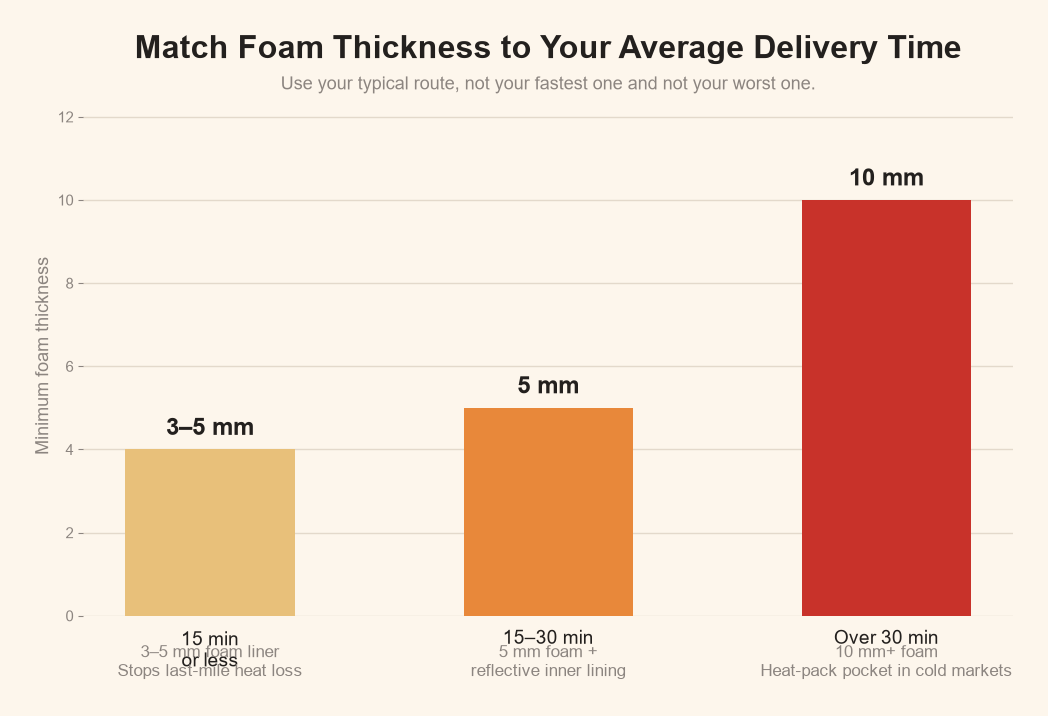
| Average route | Minimum foam | What else you need |
|---|---|---|
| 15 minutes or less | 3–5 mm | Standard liner is enough, since the bag only has to stop last-mile heat loss |
| 15–30 minutes | 5 mm | Reflective inner lining, because most generic bags start failing in this band |
| Over 30 minutes | 10 mm+ | Heat-pack pocket for cold-weather markets; ice packs for chilled items |
Insulation thickness is a cost and weight trade, not a “more is better” scale. A bag rated for a sixty-minute hold is heavier, bulkier, and more expensive than one built for twenty. So buying that capacity for a route you drive twice a month wastes money on every other delivery, while buying under your median loses customers.
Four Kitchens, Four Different Bags
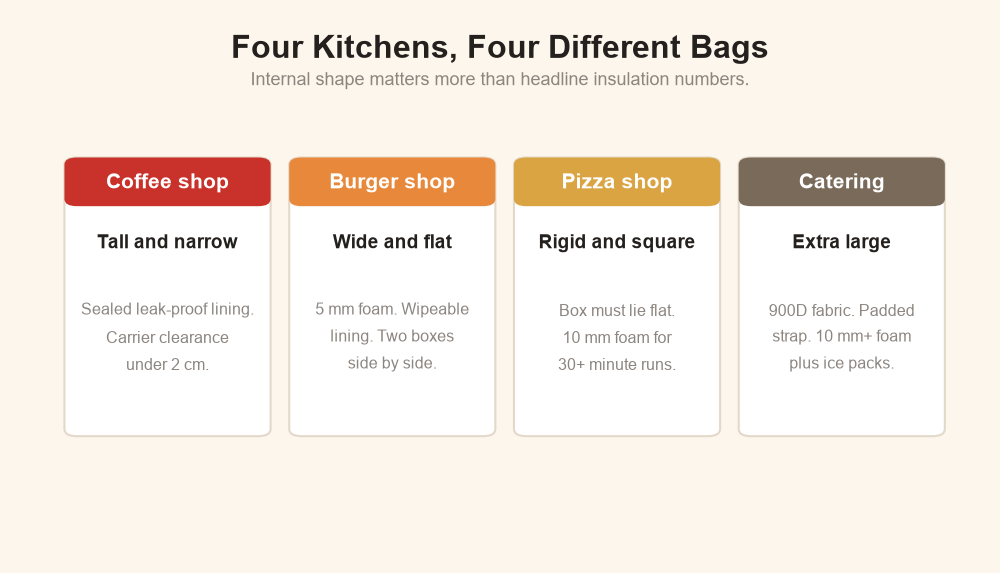
Insulation gets the attention, but internal shape is what determines whether an order arrives intact. These four profiles cover most delivery operations.
Coffee Shop: Small, Frequent, Liquid-Heavy
Drinks have to stay upright and hot, and spills are a question of when rather than whether.
You want a tall, narrow interior. If the bag is wider than the drink carrier, the carrier tilts, and a tilted carrier empties itself. Measure your carrier, then allow no more than two centimetres of extra width. The lining has to be sealed and waterproof, because coffee that soaks into foam never fully leaves it. A zipper closure holds heat and also keeps the smell of the last order out of the next one.
Condensation on cold drinks causes a separate problem worth understanding: see cold drink condensation during delivery.
Burger and Sandwich Shop: Boxed Orders, Short Radius
Boxes need to stay flat and fries need airflow, so the bag should be wide rather than deep. If your staff have to stack boxes, then the bottom one arrives compressed.
Five millimetre foam covers a fifteen to twenty minute radius. Prioritise a smooth, wipeable interior instead, because grease and sauce accumulate fast and a textured lining is impossible to clean properly between shifts. As a sizing test, your largest box should touch both sides without being squeezed, and ideally two should sit side by side.
Crispness is as much a container problem as a bag problem, which preventing soggy takeout packaging covers in detail.
Pizza Shop: Large, Flat, Easily Ruined
A crushed pizza is a total loss and a refund, so structure matters more here than anywhere else.
The bag has to hold a standard box completely flat, and it also has to keep its shape when empty, because a floppy bag collapses onto whatever is inside it. Although pizza retains heat reasonably well on its own, past thirty minutes you need 10mm foam or the cheese congeals before arrival.
Test it with a fully loaded box and the zipper closed. If there is any compression at all, the bag is too small, and a pizza bag an inch under size is a bag nobody uses. Start from your box dimensions using our guide to choosing the right pizza box.
Catering and Meal Prep: Heavy, Mixed, Long-Haul
Multiple trays, hot and cold together, long distances, and a bag that gets loaded and emptied dozens of times a day.
You need extra-large capacity, ideally with compartments, and construction that survives the handling: reinforced handles, a heavy-duty zipper, and 900D polyester rather than lighter fabric. Since a loaded catering bag can pass thirty pounds, a padded shoulder strap stops being a luxury. Insulation should be 10mm or thicker with a reflective lining, plus ice packs for anything chilled.
Catering is also where food safety rules bite hardest, because the food sits before it is served. USDA FSIS applies a two-hour rule to delivered perishable food, dropping to one hour when the air temperature is above 90°F, and recommends packing cold items with plenty of ice or frozen gel packs. So build your bag spec around that window, not around the drive time alone.
Load your heaviest tray and lift by the handles. If the stitching pulls or the handles feel thin, then the bag will fail in month two. For the containers going inside, see the best disposable catering packaging for events.
The 30-Second Test Before You Order in Bulk
Product descriptions are written to sell. A physical sample, however, tells you more in half a minute than a spec sheet does in ten.
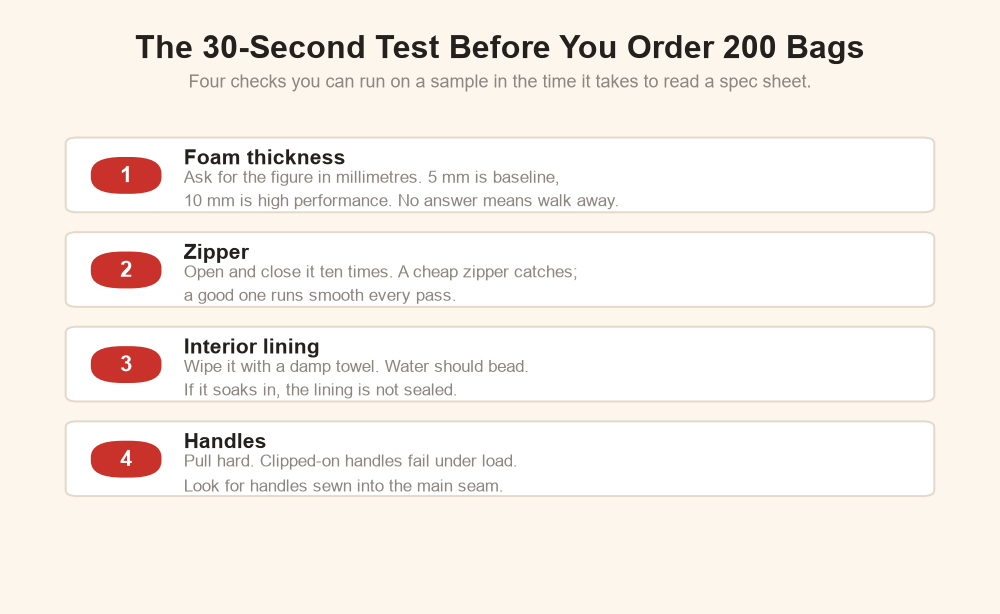
First, ask the supplier for foam thickness in millimetres. Five is baseline, ten is high performance, and if a vendor cannot answer, that itself is an answer. Second, work the zipper ten times, because a cheap one catches from the first pass. Third, wipe the lining with a damp towel: water should bead, and if it soaks in, the lining is not sealed and cannot be sanitised properly. Finally, pull the handles hard. Clipped-on handles fail under load, while the ones you want are sewn into the main seam.
The same scrutiny belongs on the supplier, not just the sample. How to choose a restaurant packaging supplier covers what to verify before a first order.
When a Custom Insulated Tote Bag for Food Delivery Pays for Itself
A branded bag is advertising that moves. Drivers carry it through lobbies and down streets, and customers who keep it carry it to the grocery store.
| Condition | Threshold where custom printing pays |
|---|---|
| Daily delivery volume | 50 orders or more |
| Average order value | Above $15 |
| Planned service life | 6 months minimum |
Below those thresholds, plain stock bags usually make more sense, since the print premium is hard to recover. Above them, however, the bag stops being a packaging cost and starts behaving like a small, recurring ad spend you have already paid off. Our guide on measuring branded packaging ROI covers how to track that.
Fusenpack provides free design service and branded mockups within 36 hours, so you can see the finished look before committing to quantity. The Custom Reusable To-Go Bag supports custom sizes, print colours, and structural changes rather than fixed configurations. If you are weighing this against staying with disposables, our comparison of insulated tote bags versus paper bags runs the six-month numbers.
Making the Bags Last
Commercial use kills bags faster than anything the manufacturer can control. Five habits account for most of the difference between a bag that lasts two years and one that lasts four months.
- Preheat before hot loads. Run hot water inside for thirty seconds and empty it, because otherwise the foam absorbs the first few degrees off your food.
- Keep hot and cold separate. If one bag holds both, everything drifts toward room temperature faster than either would alone.
- Stop at 80 percent full. Overstuffing compresses the insulation and also puts load on the zipper and handle seams, which is where failures start.
- Clean at the end of every shift. Wipe inside and out with a mild sanitising solution, then dry with the zipper open, since mould begins in damp closed bags.
- Store open and dry. A damp bag zipped shut overnight will ruin its own lining.
Frequently Asked Questions
How long can an insulated tote bag for food delivery keep food hot?
A bag with 5mm foam and a reflective lining typically holds food above 140°F (60°C) for 30 to 45 minutes. Ambient temperature, how full the bag is, and whether it was preheated all shift that figure. For longer routes, therefore, move to 10mm or thicker foam or add heat packs. The 140°F figure comes from USDA FSIS guidance on holding hot food, not from bag manufacturers.
What size insulated tote bag is best for food delivery?
The one that fits your largest container without compressing it. Measure your most common takeout or pizza box, then add one to two centimetres of clearance per side. Buying by size label rather than measurement is the most common ordering mistake.
Are insulated tote bags waterproof?
Not automatically. You need a sealed waterproof inner lining and a water-resistant outer fabric, although many budget bags have neither. Test by wiping the lining with a damp towel: water should bead rather than absorb. This matters most for soups, drinks, and anything that condenses.
Can insulated tote bags keep food cold?
They slow the temperature change rather than actively cooling. So for chilled items, always add ice packs or frozen gel packs, which is also what USDA FSIS recommends for transporting cold take-out food. Cold food should stay at or below 40°F. The insulation extends how long that holds; it does not create it.
Can I customise an insulated tote bag for food delivery with my logo?
Yes. Most manufacturers, Fusenpack included, offer custom sizes and printing. Because printing runs up to five Pantone colours, brand colours match exactly instead of approximately.
How do I clean an insulated food delivery bag?
Wipe the interior and exterior with a mild sanitising solution after each shift, then air dry completely with the zipper open. Never submerge the bag, because water trapped in the foam layer damages the insulation and does not fully dry out.
Where to Start
Measure your median delivery time this week, then measure your most common container. Those two numbers narrow the field faster than any product comparison will, and they also tell you which of the four kitchen profiles above you are actually running.
After that, get a sample of the insulated tote bag for food delivery you are considering and spend thirty seconds on it before anyone signs off on a quantity.